
 As many independent recruiters start to explore adding split placements to their business model, different questions arise as to whether they want to split profit, why they would pay to join a network, and most importantly what belongs to whom? Recently picking up the game of tennis, I think many aspects of tennis can be related directly to recruitment and split placements, and perhaps this will give a new perspective on this business model to those on the fence. Read the rest of this entry »
Independent Recruiters, Split Placements, and Tennis
by Sarah FreiburgerAnatomy of an International Split Placement
by Veronica Blatt From time to time, prospective NPAworldwide members, new members, and even some of our existing members will ask what is involved in making an international split placement. Here is a real-life example of how one such deal came together. The recruiters were Taufik Arief from People Search Indonesia in Jakarta and Julie Parsons from Premium Consulting in Brisbane, Australia. They share their story below:
Who had the job?
Taufik: I received the job opening from my client. Our firm had filled a role for them within our region, which resulted in receiving this new job opening in Brisbane.
Taufik, how did you make your NPAworldwide partners aware of the role?
Taufik: I posted the opening on the NPAworldwide online sharing tool, SplitZone.
Julie, how did you become aware of the opportunity?
Julie: I have a search agent set up that automatically sends me all new job openings in Brisbane. Taufik’s role was included in the search agent.
Had you previously worked together on an international split placement?
Julie: No, this was my first introduction to Taufik. We did get to meet each other face-to-face eventually at an NPAworldwide conference in Beijing, though!
How were candidates sourced?
Taufik: Julie worked the job from scratch to find the candidates.
Julie: I knew I could fill it if I had the trust of my partner and his client.
What was the interview process like?
Julie: Initially, it was NOT easy – there were too many people involved! Taufik was the point of contact with the client in Indonesia, but we also had involvement from HR in China, HR in Singapore, the headquarters in Sweden, plus a hiring manager and me in Australia working with local Brisbane candidates. We had about 2-3 attempts at the job and lost some good candidates because the process was too slow due to all the different people involved from different locations. Once I was able to take direct control of the interviews with the local hiring manager, everything ran smoothly.
What was the offer process like?
Taufik: It took about 3 months from the start to the offer/acceptance. Once we got the client dealing directly with Julie and the local candidates, it was not too difficult. My client needed some assistance and advice in packaging the offer to make it acceptable to Australian candidates.
Were additional hires made?
Taufik: Actually, from the final shortlist of 3 candidates, the client hired two people even though we were only officially working on one vacancy! The client was very impressed with the caliber of candidates that we put forth. Both candidates are still working for the client, and both have been promoted.
Did the candidates have to relocate?
Julie: One candidate was originally from the UK but had just recently moved to Brisbane where the job was. The other candidate was an Iranian living in Sydney; he did move to Brisbane.
Were there any special circumstances such as a visa?
Julie: No visa issues, but we did provide real estate information for housing.
Any other comments you would like to add?
Julie: This was a good experience. Taufik gained additional revenue from 2 more jobs filled due to the initial service the client received. We were able to fill jobs we never had – jobs we would not have received on our own.
Taufik: We have been able to keep expanding our services geographically with this same client with help from our NPAworldwide trading partners. We have made placements for this client in Indonesia, Singapore, and Australia and are now working on a role in India. Collaboration with my partners helps us perform well for our clients, leading to more roles, leading to more collaboration – it is a very positive circle!
Thanks for sharing, and congratulations on your success!
The recruiting process is basically the same whether you are working locally, regionally, nationally, or internationally. Sure, there may be some additional elements, like time zones and visas, that can lengthen the process. With the right partners, recruiters should feel confident saying YES to the clients and to an international split placement!

Recruitment Benchmarks to Consider
by Dave Nerz Entrepreneurs like to keep score. OK, that is a generalization but seriously, how do successful people become successful? They hold themselves accountable and they set targets. So my question is, as an independent recruiter or recruitment firm owner do you have someone that you compare your success with on a regular basis? Benchmarking is the term many use. Read the rest of this entry »
Sell Yourself to Clients: 5 Recruiter Strategies
by Sarah Freiburger Apple CEO Steve Jobs had a particular way to sell yourself or your brand whether you were an average job seeker, a manager, consultant, or even a CEO. Presentation skills not only help sell ideas or products; you can also us them to elevate your personal brand, which as a recruitment firm owner, is essential in establishing yourself to clients. Consider these Steve Jobs techniques on your next presentation. Read the rest of this entry »
The 3 F’s of Employee Retention
by Veronica Blatt Today’s post is courtesy of Joshua Ro with People Consulting Group in Seoul, Korea. People Consulting Group places senior executives in manufacturing, information technology, consumer products, banking and finance, telecommunications, logistics and distribution, professional services, entertainment, and fashion. Joshua serves as a member of the NPAworldwide Board of Directors.
Recently, I attended a human resources seminar where most of the attendees were foreign companies doing business in Korea. There I had an opportunity to speak with a HR Director of McDonald’s Korea and she mentioned that they have a high rate of employee retention. The reason is 3 keywords their employees have identified: Family & Friends, Flexibility and Future. McDonald’s Korea’s staff members and employees feel they belong to a Family & Friends, enjoy Flexibility at work which drives better performances, and see a vision for the Future in getting promotion and opportunities.
Then I came to think about the implications of these three key factors in successful employee retention in our own field. The recruitment industry is somewhat notorious for having a high turnover rate.
I understand making staff members and employees feel they belong to a family and/or group of friends is a key factor in retaining them. Amongst any group, there must be some who are doing better than others, yet others who are struggling. Surely it would be your desire to have all of your family members perform well. Thus, investing your time to make them feel they are a member of the family may encourage that high performance and ultimately help you to retain your staff and employees.
Another key to employee retention is providing flexibility at work. We are so used to working from 9:00AM to 6:00PM, but it is important to recognize the different situations of each staff member and employee. Offering flexibility at work, such as giving different options in working schedules, will certainly lift their burdens off from their shoulders and lead to higher performance.
Lastly, envisioning a realistic and tangible future (not a transient one) at work helps retain staff members and employees. Setting goals and making them see what is achievable triggers their sense of fulfillment and satisfaction. This means employees have to see the benefits and rewards generated from both their work and your organization.
Retaining staff members and employees, especially the high performers in the recruitment industry, is challenging. Addressing the “3 F’s” of Family/Friends, Flexibility, and Future improves employee retention and may also increases their job performance and overall satisfaction.

No One Wants to Work with “Recruiters”
by Dave Nerz I recently attended a conference of global recruiters. New business development for recruiters was a topic of conversation. Attendees agreed that it is becoming increasingly more difficult to cold call into prospective client companies. A big part of the challenge is “recruitment fatigue.” Employers are just plain tired of hearing from recruiters and refuse to take the calls or return messages left. Nothing new there. The big “a-ha” was that it often has to do with the way you position your service offering and the title you announce yourself by on each prospect call. Read the rest of this entry »
Recruitment Books to Read This Year
by Veronica Blatt It’s the start of a long holiday weekend here in the USA as well as a popular time for summer vacations. In between barbecue and fireworks, I’m hoping to find some time to read some recruitment books. How about you? If you’re in need of some ideas, Social Talent has compiled a list of 12 Books Every Recruiter Should Read in 2014. A few that I’ll be adding to my list are: Read the rest of this entry »
Behind the Scenes of a Global Recruitment Network
by Sarah Freiburger As the Director of Membership at NPAworldwide, a recruitment network, I am often asked this question: So who runs this network? As a network that is member-owned and run, this is a multitiered question at best, and does not apply to every online network that you may find. However, here is the breakdown of what is happening behind the scenes at our specific split-placement network. Read the rest of this entry »
Mobile Job Search Is the New Normal
by Veronica BlattIt’s official. Mobile job search is mainstream. Earlier this week, Indeed announced its acquisition of MoBolt, a technology platform that allows job seekers to apply directly for any job, from any device. Further, in the same announcement, Indeed reported that half of all Indeed job searches are performed on a mobile device. Yet only a small percentage of Fortune 500 employers provide a fully-mobile job application process. The Indeed/MoBolt relationship means virtually any employer can now accept mobile job applications, without any IT integration.
A recent infographic from Beyond.com indicates that 64% of job seekers prefer to use a smartphone for job search activities because they can search for jobs anytime, anywhere. However, only 8% of survey respondents indicate that it is EASY to apply for a job via their smartphone. Nearly two-thirds of respondents said when they find a job of interest on their smartphone, they wait until later to apply via a desktop computer. Click the image below for the full infographic:
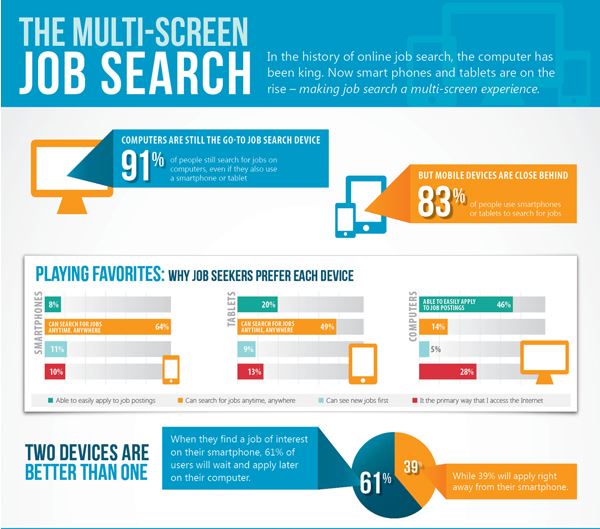
And here’s the rub: other research indicates that job applications must be received within the first 72 hours after posting or are 50% less likely to even be opened. Forcing job seekers to ‘come back later’ because the mobile application process is so cumbersome means a lot of job seekers won’t come back. Glassdoor says that 75% of job seekers will conduct a mobile job SEARCH, but only 44% will APPLY via a mobile device. That means employers could be losing out on almost half of potential applicants. In a talent short market, who can afford to lose out on even ONE great applicant?
That leads me to my final point. One of the current hindrances to applying via a mobile device is that most people do not have a copy of their resume stored on their mobile device. And most career sites still require a resume to be uploaded. So I ask, is it finally time to replace traditional paper-based resumes with a digital alternative? LinkedIn offers the ability to apply using your LinkedIn profile, but many profiles lack polish or aren’t up-to-date, and not all candidates are using LinkedIn. Similarly, Indeed offers an “Apply with Indeed” button (ZipRecruiter offers an interesting comparison between the two here), which works well for employers who post on Indeed and job seekers who search with Indeed. True, that represents a lot of employers and a lot of job seekers — but not all of them. And not necessarily the right ones. Could a link to a digital portfolio be an acceptable alternative? Can recruiters and employers and candidates (and ATS’) leverage the visual content trend so that it works for everyone? In my opinion, recruiters and employers who figure out how to turn mobile job search into mobile job applications (with a great user experience) stand to win the talent war big-time.
What are your thoughts on the disconnect between mobile job search and mobile job applications? How are you adjusting your process to accommodate mobile usage?