
Warning Signs That You’re Becoming “Yesterday’s Hero”

by Liz Carey

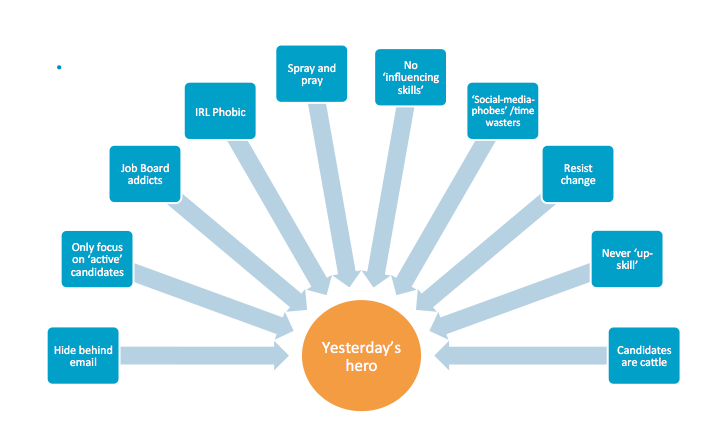
Screen-Shot-2016-05-22-at-2.03.34-PMGlobal recruitment leader Greg Savage of the Savage Truth recently posted a video stating that the recruitment landscape is littered with “yesterday’s heroes” – recruiters who don’t evolve and are stagnating.

Here are some of Savage’s warning signs you are becoming one of “yesterday’s heroes”: Read the rest of this entry »


Great Movies for Recruiters

by Dave Nerz

filmWell, I thought it was an original idea. I wanted to create a list of great movies for recruiters to watch. I learned it has been done before! If you google “Best Movies for Recruiters”  you will see other lists created by people in the industry. There are some similarities, but a few different ones on my list. Maybe you want to create your own list?


  1. Jerry Maguire, starring Tom Cruise, Renee Zellweger
    If you ever had a demanding candidate or client, this one will resound with you. The little guy working against the big competitors is a theme in this movie. Some great energy shown by the “agent” to win over his client. We all remember the “Show me the Money” moment in this film!
  2. The Pursuit of Happyness, starring Will Smith
    A true story about motivation lifting someone out of really tough circumstances. Recruiters can relate to this if you ever had a really bad day, but just had to go on in spite of the odds. Click the link to see a really tough job interview and then an offer where the candidate has second thoughts about accepting the job he fought so hard to get!
  3. Tommy Boy, starring Chris Farley, David Spade
    Tommy is working hard to save his recently deceased father’s business. Tommy faces some really tough circumstances and much rejection. While this is not a model for great sales technique, it does show the power of persistence. As a recruiter, if your recruitment guarantee has ever been questioned, this scene might strike a note with you.
  4. The Intern, starring Robert De Niro, Anne Hathaway
    A very current movie that gives an interesting look at how interviewing for interns is a very age-biased process. Good message for us aging folks that we can have value to a new generation, but it requires give and take on both sides. Worth a watch.
  5. 12 Angry Men, starring too many greats to list…
    There are two versions of this movie and both are really good. One was from 1957 and the other in 1997. This is a great study in personality profiles. If you have ever put anyone through a DISC program, it might be good to try to map the styles of each of these jurors deciding the fate of the accused. Lots of themes are present for you to consider. I often picture the selection committee on proposed candidates to be a bit like this group. See if you agree…

Post your favorite selections or additions below and keep the ideas coming…

button to subscribe to NPA blog


3 Cool Recruiting Tools to Check Out

by Veronica Blatt

hammer-nails-300Recently I heard about a great iPhone app to help schedule appointments / meetings / calls across multiple time zones. That got me to wondering what other cool recruiting tools are out there that I haven’t heard about, so I did a little research. I’m happy to say I’ve found 3 that I’m excited to share with you: Read the rest of this entry »


Are You Using Facebook for Recruiting?

by Veronica Blatt

facebook logoI’m amazed by the number of people I know who still say, “LinkedIn is for business and Facebook is personal.” This includes quite a few people in the recruiting sphere, who seem reluctant at best to toe-dip into using Facebook for recruiting. Considering the engagement level of Facebook’s enormous user base, it seems to me like there should be a whole lot more recruiting activity taking place there.

Consider the following: Read the rest of this entry »


5 Steps to a Collection Letter

by Veronica Blatt

image of folders for past due recruiting feesToday’s guest post is courtesy of Wilson Cole, founder and president of Adams, Evens & Ross, a collection agency specializing exclusively in the recruitment and staffing industry. AER is an Endorsed Program sponsor of NPAworldwide.

I must get 10 calls a month from prospective clients who ask me for collection help on a past due account, and when I ask if they have sent a final demand letter, 75 percent of them will tell me they have not. Now, I do appreciate that everyone thinks of me when they have a collection problem, and I do not like to turn down business, but I will tell you what I tell them.

I first ask: “Has your debtor told you he is not going to pay?” It does not matter why – it could be he does not have the money, he disputes he ever agreed to your services, or someone has stolen your candidate or temp. If that is the case, then I do not recommend sending out a final demand because it would be a waste of time. But these cases are the exception. My best guesstimate is that only about 10 percent of your collection issues will fall in that category.

The vast majority of your past due clients would benefit from a final demand letter from your company before you turn over the account to me for collection. The fact is that 50 percent of your debtors probably will pay after your final demand letter. Think about that. You could save many thousands of dollars every year in collection fees by simply sending one more letter. But like most things in life, you have to do it the right way. So, let me share with you a few things you can do to help insure the success of your final demand letter.

All successful final demand letters have five key ingredients that work together and make the letter more effective.

  • Ingredient one: Your demand letter must have an exact date for payment. Do not say something like “the balance needs to be paid within 10 days of this letter.” This could be confusing; does it need to be paid 10 days from the date of the letter or 10 days from receipt of the letter? Does the payment need to be mailed within 10 days or does it need to be received then? You need to eliminate any confusion, so your letter must be very direct and specific. For example, it should say something like, “I must have payment in my office by or before May 25, 2016.”
  • Ingredient two: You must state what will happen if you do not receive payment, but on this issue, you should be less direct. The fear of the unknown will work far better than specifics on this issue . I would recommend saying something like, “If payment is not received, then we will move forward with all legal means necessary.” Another reason I recommend you do not give specifics is that different debtors have different hot buttons. Some debtors are very concerned about their credit; others do not care. Some are scared of being sued; others welcome a lawsuit because it buys them up to 12 months to pay up. They may think: “Good, now I can pay them in full on the courthouse steps when or if this ever goes to trial.”
  • Ingredient three: Note that you’re sending a copy to me or your attorney. This plays back to the fear of the unknown. Your debtor may think that you have done this to lay the groundwork for any additional action you may consider in the future. It also sets up either me or your attorney if they fail to pay you. We get to borrow from your credibility.
  • Ingredient four: Send the letter U.S. mail certified return receipt requested. The cost of a certified letter is about $6.50. But the bang for the buck is huge. A certified letter triggers human fears and emotions – the fear of the unknown and the fear that you may be documenting the issue to bolster your case. You kick in a little embarrassment as well when the debtor has to sign for the letter in front of the letter carrier and his/her employees.
  • Ingredient five: Really, is a lack of an ingredient. That is, do not follow up with a phone call or email to see if the letter was received. Do not send another demand letter. The best comparison I can make is what any rookie salesperson learns in a sales training 101 course: when you ask a closing question, then SHUT UP. He who talks next will lose every time. Once you have sent your final demand, you have made your closing question, and if the debtor does not buy it, then you need to send in someone else to close the sale – in this case, convincing the debtor it is better to pay the debt than not to.

Keep in mind what I said at the beginning of this article, and that is you will collect 50 percent of the accounts to whom you send a final demand letter. For those who do not pay, the best that you can do is set up either your attorney or me for success. The fact is that you asked your debtor to pay and said clearly what you would do if payment wasn’t made. Then, when I call, I can leverage your credibility and walk the debtor down the path of events of what will happen if payment isn’t made.

The fact is if you do your job as I outlined, you will need me a lot less in the future. But in the event that your debtor does not pay after your final demand letter, the worst case is that you have set it up so I can be much more successful for you in the collection process.

Independent Recruiter Blog


Tips for Engaging Passive Candidates

by Liz Carey

HHZ5NPNR1TGood recruiters know it’s insufficient to just post a job and blast candidates on social media.  They know there’s much more to recruitment, including finding passive candidates – those that are currently employed and not necessarily looking to change jobs.

How do you approach passive candidates? It’s important to really cater your initial contact with a passive candidate to sound both professional and genuine. You want to capture the candidate’s attention, but not in a spammy way. Read the rest of this entry »


Split Placement Story: Earn Respect by Helping Others

by Sarah Freiburger

blue2-orange-fishWe have all seen an award winner accept a prestigious honor from their peers, whether in our work industry, a committee or organization we are a part of, or just on television. Whenever I see that moment of honor, I aspire to one day become someone who is looked up to and respected enough to receive such recognition. In a split placement network of close to 500 firms and over 1,300 recruiters, it is easy to feel as though your efforts are going unnoticed; however helping others when there is no financial gain for yourself is one of the true signs of a leader. The following split story highlights not only a great international split, but also a member going out their way to see others achieve success.

At a Global Conference meeting held in Denver, CO, a member, Jim, from Georgia, connected with several strong members in the network, one being the regional director for the Canadian membership, James. Jim’s firm planned to work several international roles and he has been hoping to find some solid candidate providers they could reach out to at this meeting.

As a follow-up to the meeting, Jim emailed James with a General Manager position in Canada that he was going to be discussing with his client that very afternoon, asking James for advice on how difficult the role looked to source, who could help source for this role, and any other help James could provide.

Many times, when something like this crosses your desk, you immediately get selfish and consider whether the job is in your industry, if you could take on the recruitment for it, and what is in it for you and your business. If it is not a match, which in this case it was not as James does nothing with regards to pumps/fluids, it would be really simple to not respond to the email and carry on with your day. However, that lack of response is doing nothing to build up respect for your name or brand, and also not helping the organization you belong to.

Instead, James racked his brain for fellow members he knew of that worked that particular space and took the time to introduce Jim to fellow Canadian member, Henry. He worded it exactly like this, “I don’t know anything about pumps/fluids but if I had that order the first guy I would call would be Henry.” How reassuring to hear such confidence in someone able to assist you, likely hours or minutes before you take a client call.

Well, James was completely correct in his introduction, and not only was Jim able to secure the role from his client, a 100,000+ job at nearly a 30% fee, but Henry successfully sourced it, and the two ended up splitting a $33,000 fee, with the added benefit of a happy client now knowing that the firm can handle those international positions well.

While James did not get a portion of that fee, he now has two very happy members that appreciate and respect him for connecting them, and I am sure that the next time he needs a favor or job filled, they will return the favor of responding to him with any help they are able to. I encourage you to stop the next time your mouse hovers over the “delete” button on your email to first consider what other options or reply you could provide the partner on the other end.

5 Strategies That Have Shaped Our Recruitment Firm’s Success

by Veronica Blatt

backgammon-300Today’s guest blogger is Bill Benson with WilliamCharles Search Group located in Grand Rapids, MI. WilliamCharles is an executive search and professional recruiting firm specialized in finding managerial and executive talent in finance, HR, operations, sales/marketing as well as president/CEO roles. They have a concentration of clients in Michigan but they also work across the US. Bill is the secretary/treasurer of the NPAworldwide Board of Directors.

Over the years my business partner and I have tried many things. Many of those ventures, ideas or new approaches have either not worked well or completely failed. Fortunately… some of those strategies have taken seed and helped us build our recruitment firm. Here are five GOOD decisions that we have made along the way.

  1. We focused more on the middle market rather than large companies. This gave us more opportunity to build a value-added relationship with decision makers rather than recruiters. It enabled us to function more as partners rather than vendors.
  2. We decided to take an intentional approach toward placing the relationship ahead of the transaction. This led to a concerted focus on quality at every interface with the client. We decided we needed structured processes in our recruitment firm that ensure consistency for taking more in-depth job orders, more detailed candidate submission process, 360 degree references, etc. Our quality standards became part of our marketing pitch and it also has driven the need to be more selective working only on “A” job orders.
  3. We cut our ties to job boards and exclusively focused on recruiting passive candidates. How much value do you add by simply working the same candidate pool as your clients? We have learned that old school recruiting of passive candidates adds more value and is much more sustainable when times get tough.
  4. We ventured into engaged and retained search. Doing this provided the following benefits: forced us to build more client service into processes, increased the average size of our fee and gave us greater credibility even with our contingent clients. We have a nice mix of business between retained, engaged (contingent with a commitment fee on the front end) and contingent.
  5. We joined NPAworldwide. We had some success making splits, which was our main reason for joining. NPAworldwide has allowed us to expand our geographic reach and our functional capability. While this does not always result in a split, it does always provide additional candidates to our clients which leads to a higher close rate. We have also had many side benefits of being part of this network. Many of the ideas we have employed have come with some connection to NPAworldwide, either through a sponsored training program or member best practice. We take advantage of many of the sponsor partnered discounts.

Usually the road to success winds through good decisions and bad. The key is to timely dump the bad decisions and be patient and allow the good things to come.

image of button for free checklist to evaluate split placement networks


Split Placement Etiquette: 6 Rules for Success

by Veronica Blatt

top-hat-bowNPAworldwide turns 60 this year. Our members have made a LOT of split placements during that time. We think we’ve learned a few things about how to succeed at splits. While it’s true there are a lot of different ways to be successful, there is some split placement etiquette to follow that can make it a smoother process. Below are a few tips whether you are supplying the job or the candidate:

If you have the job…

  1. Be committed to a successful split placement outcome. This means you want help, you need help now, and you want to close a deal. It may mean asking for help selectively as opposed to blasting out a generic post. Good recruiters will not get excited about your job if they are one of 10 recruiters on a list. Be willing to share important details with your partner about the client and the job location – this will help your partner hone their sourcing efforts.
  2. Make sure it’s a good, fillable job. Even if it’s for a purple squirrel, the job should offer an appropriate salary and fee. Ideally it’s with a client you’ve worked with before, where you have a good relationship and a successful track record of placements. It helps if the job is with a desirable employer in a desirable location, but that is not a requirement.
  3. Provide timely feedback to your trading partner. When you receive candidates, acknowledge that you received them and let your partner know if they are a good fit. If not, tell your partner why and how they can be more on-target.

If you have the candidate:

  1. Call your trading partner BEFORE beginning any search activities. Make sure the job is still open, find out what has already been done, and if there are any candidates already interviewing. This also gives you the chance to find out if anything has changed from the posting, or if there are any other details that can help you source more effectively.
  2. Find out how your partner likes to work. Generally, the person with the job will be the “lead” on split placement activity, since they are working directly for the client. Some recruiters want a lot of involvement from their trading partners; others want hardly any. Don’t infringe on your partner’s client relationship.
  3. Make sure your candidate is appropriately qualified. If you have a candidate that *you* think is great but doesn’t match up with what the client is looking for, it’s probably best not to submit that candidate. Make sure the candidate’s contact information and resume are current. The salary expectation should be in line with what the job offers. Ideally, you can share insight about the candidate beyond what is included in the resume.

It goes without saying that clear communication, in advance (preferably in writing), is required from both partners in order to manage the process. I would venture to say that more than 90% of the difficulties that can arise on a given split placement can be attributed to unclear communication or mismanaged expectations. Remembering the importance of good communication plus following good split placement etiquette is sure to increase your chances for success.

Independent Recruiter Blog


A Checklist for Recruiting Exceptional People

by Amy Teske
Please ensure Javascript is enabled for purposes of website accessibility