7 Cool Recruiting Tools – FREE

by Terri Piersma

Business NetworkNPA, The Worldwide Recruiting Network, a split placement network with members on six continents, held its 2013 Annual Global Conference in Las Vegas. Recruiters from around the world met to develop or renew relationships with their split placement trading partners. In addition, five industry trainers presented on a variety of recruiting industry topics. One of the trainers, Bill Boorman, spoke about 14 cool recruiting tools. This post will briefly describe seven of those tools. All the tools listed below have FREE versions. Read the rest of this entry »


What do the Mayans, the Fiscal Cliff and Recruiters Have in Common?

by Veronica Blatt

mayan-templeToday’s guest blogger is Doug Beabout, from The Douglas Howard Group and Recruiter e-Learning. Doug brings over thirty-five years of expertise in personal top billings, personnel services firm ownership, and industry training. His tenure in executive recruiting has resulted in his personal success at building four highly successful executive recruiting and executive search businesses as owner. Doug works a search “desk” every day in both the medical and automotive products industries. He is uniquely qualified as a personnel services industry trainer. Many of his clients have put their net worth and corporate objectives and achieved recruiting excellence because of his training and guidance.

Recruiters are separating today into two very different groups. First, the group that has reported 2012 as a great year for placements, secondly, those recruiters who are failing at record rates causing even greater attrition across 2012. We are experiencing a very fertile and historic phenomenon. Nearly all employers report they are unable to find critical talent. 2012 has been a historic year for us (and many with whom I interact) in that contingent fees are being eclipsed by eager employers who are happily engaging in container search or in other words, paying a sizeable portion of the fee in advance on a search they simply cannot continue leaving unfilled.

Conversely, a large number of companies cling to the notion that putting multiple contingency recruiters in a race to their door with candidates is in their best interest. Many employers do this to leave the possibility on the table that a candidate may stumble upon their doorstep and they can avoid the expense of a recruiter’s fee. Common sense says that is not a prudent choice. Recruiters put little if any loyalty or serious commitment into a client who harbors this belief. In reality, recruiters often move on from a simple contingency search in about two weeks if they fail to discover a qualified candidate. This practice has been common since I joined the recruiter ranks thirty-five years ago. Recruiting agreements like this have never served either party as well as either side expected.

This recruiter is not saying that a contingent fee search is to be avoided. I am saying that if you accept a search on contingent terms, do so if the client is amenable to signing an exclusive right of referral for a reasonable period. Thirty days was a commonly acceptable time frame but in recent months, most recruiters and employers report a significantly longer time to fill a professional position. The reason is mathematically evident; the candidate pool is less than one-half as populated as it was just a few years ago.

2013 holds an incredible potential for well-trained and disciplined recruiters who engage with employers as true partners in the search process. Employers that become great clients in the days ahead will have come to realize the value of this form of engagement. It is incumbent on us as recruiters to develop trusted relationships based upon a value-added search process and we must avoid the typical transactional approach we take or capitulate to when approaching employers.

I have seen five past recessions and various states of economic recovery. The emergence of the PC, Internet and technology centric recruiting tools have caused concerns for recruiters who saw them as a threat to their value and subsequent success. The recruiting industry grabbed every possible asset from all these. Human resources also did. Soon thereafter, recruiters who chose to drop their fundamental recruiting practices and replace them with technology-based practices had a period of success while the active candidate pool remained well populated. Literally, thousands of recruiters have struggled in the last few years as the candidate pool shrank by retiring baby-boomers. While the mouse and keyboard replaced the telephone as a primary tool, recruiters saw rapidly diminishing results due to their lack of hard skills in sourcing, recruiting and managing a recruiting process. These hard skills are the foundation of all successful recruiters’ practices and processes.

Many employers continue to use the job boards, candidate pools, professional sites with very limited success when seeking critically skilled professionals. Those that have become great clients toady accepted the fact that what once worked well is failing and are seeking a “better way”. These employers exist in every industry and they are awaiting or seeking a solution to seize talented people. They are waiting on that call that offers them the answers.

The past couple of years have been no doubt a challenge for most of us. What is keeping many recruiters from picking up that telephone is fear of failure and rejection. The technology tools offered a low exposure to rejection that enjoyed by many recruiters. The big problem now is that recruiter comfort in failing passive practices has served to increase what is labeled as “Call Reluctance”. This malady has stifled many recruiters who are starting out as rookies. I have trained thousands of recruiters and helped them face this head-on with success. Now, it is much more deeply rooted and cannot be overcome by the simple advice of “just jump in the cold water because you will soon become adjusted to it”.

Encouraging a person to pick up the telephone once they have the training required to perform is one thing, it is entirely another when one’s fear of the telephone is based upon their comfort of more passive steps such as a PC mouse and the keyboard. This person, lacking the hard skills training to perform, can rationalize their reluctance to “dial”. Until they give up on a failed comfort and become determined to adopt contact-based recruiting, they will continue in their rationalizations. Sadly, I have seen throngs of people hold on fiercely to those efforts until they simply quit recruiting and look for a living elsewhere.

Throughout 2012, I heard an increasing number of employers confess that they just cannot find the people they want to hire and that the techno-toys are not producing the results they need to locate talent. Once they learn about how we can apply a direct recruiting process that capitalizes on the hard skills they lack, they are all ears (pun intended). Clients will understandably seek a cost-effective approach to talent acquisition. While key positions remain open, they continue to suffer losses of revenue and staff resulting in massive cost.

The fee a recruiter charges is easily justified when the recruiter compares it to what they can discover about losses in a relationship-based approach. Once won over by this simple mathematical comparison, employers expect to see much better and faster results. Attempting to deliver the people by applying the ineffective attempts of employers is a failure awaiting a date. Recruiters have run out of excuses and rationalizations now. They must “buck-up” and accept the fact that they must master recruiter as a “contact sport”.

Employers have failed widely hiring third-party recruiters to internalize the skills they could possess. Frankly, I see no sane reason why a recruiter who, on just an average basis, is earning over $150,000 as a consultant, taking a huge drop in income to fulfill the role of an internal recruiter. I am not saying that internal recruiters are always inept. I am simply stating that they can be of greater service where financial incentives are much higher. Further, the person hired from our ranks in the third-party recruiting industry to reduce the recruiter fee expense often becomes a coordinator of referrals from third party recruiters who attempt recruiting in the passive manner that fails the employer that hired them. Does this sound like an effective solution? In my experience, this common scenario fails employers and deters hard-skilled recruiter from serving those employers.

The time has finally come when we must master the skills that empower us to penetrate desirable sources of talented people directly or in other words, on the phone not the computer. I am not advocating that we turn our computers into boat anchors and forsake ourselves of the intelligence that lies on the information highway. What I do recommend is that we respect the prime hours when “we can reach out and touch someone” and develop the core competencies needed to be effective recruiters in a very shallow talent pool. U.S. Bureau of Labor Statistics reports that less than 4% of the professional population is unemployed. Why seek the few when the many are reached by a skilled telephone conversation. It is what employers expect us to do. It is also something they widely avoid doing for themselves; I ask you, “Can you think of a better time to be in our industry?”


Independent Recruiters: Embrace the Mobile Job Search

by Veronica Blatt

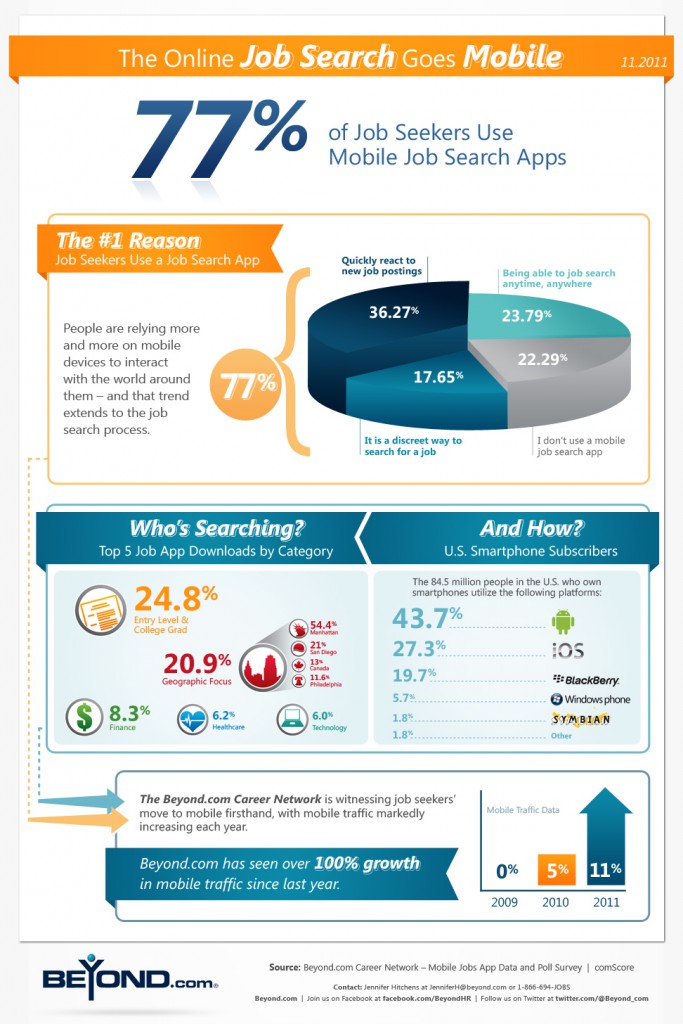
There’s no doubt you’ve heard that the job search  is increasingly going mobile. With every generation embracing mobile technology, it’s important for independent recruiters to make sure their websites are mobile friendly. If you are using jobs boards as well, definitely take a second to make sure their platforms load properly on a mobile device. The infographic below, courtesy of Beyond.com, is more proof how important it is for independent recruiters to take the time to make sure they aren’t frustrating job seekers.

Recruiting Infographic


Selling the Services of Independent Recruiters

by Terri Piersma

applesRecently I read an article by Ken Forrester entitled Placement Fees are Cheap When You Look at Them This Way. The article appeared in the online version of The Fordyce Letter in January 2013. Independent recruiters involved in recruitment in North America as well as those involved in international headhunting will find this article informative.

Ken shared how he made the following statement during a presentation to business owners and HR professionals:

“If you are not using headhunters as your primary recruitment weapon, then      you are not hiring the best talent in-the-market.”

One audience member became irate and said – “You don’t know what you’re talking about because we hired some pretty good people, and they are working out just fine. And we didn’t use headhunters.”

Well, without hesitation, Ken replied:

“Sir, you are absolutely correct. You really don’t need headhunters to hire the best talent on-the-market. However, what would you say was the difference between the best talent in -the-market and the best talent on-the-market?”

As Ken shared with the audience – “the best talent in-the-market are most likely those individuals who ARE NOT actively searching for a job.” In other words, Ken was talking about what the recruitment industry calls passive candidates.

Experienced recruiters take the time to search for passive candidates and build relationships with them. They will contact passive candidates working for a company’s competitor searching for the top achiever willing to switch jobs for an improved standard of living and/or career advancement.

In addition, Ken shares his thoughts that headhunting means “recruiting ahead of the need” as well as a sharing a convincing explanation of how a recruiter can sell the economic value of an organization hiring a headhunter.

As an independent recruiter, how do you sell your services to organizations.


Independent Recruiters: 8 Principles of Recruitment Success

by Veronica Blatt

ToolboxI was doing a little early spring cleaning at work last week and found a postcard with Ross Clennett’s 8 Principles of Recruitment Success. I have no idea where this postcard came from or how long it’s been on my desk but I was happy to find it and thought it would make a great blog post for independent recruiters. Ross Clennett, The Recruiter’s Recruitment Expert, is a seasoned speaker, trainer, writer and coach and ‘has been an in-demand expert on recruitment in the Australian recruitment industry.’  I’ve outlined Ross’ 8 Principles of Recruitment Success for you below. Read the rest of this entry »


Independent Recruiters, How About a Little Candidate Love?

by Veronica Blatt

There’s been some lively discussion among the NPA ranks this week about the perils of neglecting candidates. While many (most?) recruiters say they work for the client—and I don’t disagree, because that’s who pays the bills—it seems timely to remind independent recruiters not to forget about the candidate. Especially in the candidate-short market recruiters are facing today.

Candidates have options. Lots of options. You’re not “doing them a favor” by helping them take important steps in their career. Independent recruiters and clients who aren’t responding to candidates in a professional, timely manner will lose out to those who do.

Qualigence International, the largest recruitment research firm in the US, recently conducted a survey on what recruiters and hiring managers consider their primary focus in 2013. The most shocking detail? ZERO said “making sure the candidate is satisfied.” Take a look at the other results in the [INFOGRAPHIC] below:

Candidate-Satisfaction

What are YOU doing as an independent recruiter, to show your candidates a little love?


Work “Coopetively” to Make More Split Placements

by Veronica Blatt

hands-blurred-tug-of-warToday’s guest blogger is Rick Corey with OpticsProfessionals, LLC in Rochester, New York, USA. OpticsProfessionals specializes fields of optics, photonics and imaging technology. OpticsProfessionals, LLC assists employers in staffing key talent, while helping individuals with career transition and growth opportunities. Rick is the immediate past chair of the NPA Board of Directors.

As a recruiter, do you ever work cooperatively with recruiters from other firms to make split placements?

I have done this a number of times, reaching out to someone who may be viewed as competition, but who could also be a trusted partner. It can be a recruiter I ask for assistance with if I’m having a problem coming up with appropriate candidates, or a recruiter I know that has some great connections into a company and I’ve got the perfect candidate.

In any case, it’s a recruiter with a good, ethical reputation; someone I feel I can trust. We make an agreement as to how we will work together on the split placement (usually a 50/50 split).

Years ago, I kept hearing of a recruiter working in the same field I do. I would call a candidate with a job order and find out the “other recruiter” had already called him. And it turns out he was hearing the same about me. He called me one day and left a “stinging” voicemail. I called him back and invited him to lunch. We met, and our respect for each other greatly increased.

From that day forward we worked on a number of split placements together, and to this day are the best of friends (he retired from the business a couple of years ago).

A client of mine once coined the term “coopetition”… working with a competitor for the betterment of both companies. That’s what I like to think when I’m closing deals with other recruiters: coopetition.

explore-membership


Mobile and the International Recruitment Agency

by Dave Nerz

hand holding smartphoneSocial media and social recruiting have been a part of the global recruiting lexicon for a few years now. It seems that mobile recruiting is on the verge of surpassing social recruiting as the red hot topic for 2013 if you work for an international recruitment agency.

The average international recruitment agency is lagging far behind other professions and industries in leveraging mobile technology to improve the user experience. Many ATS systems consider mobile the ability to shrink the full website to a size that fits on a smartphone screen. Users of mobile technology are not apt to accept that solution as on par with the overall market’s expertise. The benchmarks are in sectors like banking, retail, restaurants, publishing, news, and travel. The handset is a powerful tool to navigate what is new and needed in all of these sectors. Most recruitment sites scream, “I dare you to use me!”

LinkedIn has provided a tool that is getting greater use and holds promise for mobile interface sessions with candidates. The “LinkedIn Apply” feature creates a great way for candidates to send details via mobile applications without connecting their PDF or Word resume via a handset session. I’m guessing that many candidates would not have the know-how or patience to cut and paste a Word resume into a mobile app or into a more traditional site viewed via a Smartphone handset. But they certainly have the ability and comfort using their LinkedIn profile to introduce themselves to an employer, recruitment company or recruiter.

When recruiters moved into social media it was a continual challenge to find ways to engage candidates with information they wanted. With mobile, it is not about what candidates want to do via mobile—because they will do anything and everything you allow. It is about playing catch-up to other sectors that have moved far ahead of the average recruiter in an international recruitment agency. Banking allows you to take pictures of checks and make a deposit electronically. I’m looking forward to a recruitment site that allows you to take a picture of your resume and submit that as an application for an opening.

So for all of us that have pushed mobile aside to focus our attention on social media, wake up and smell the smartphones! Social media has morphed itself into a mobile discussion. Get ready to take on the challenges that 2013 will provide to anyone running an international recruitment agency!

Image courtesy of Ambro at FreeDigitalPhotos.net

7-trends


7 Recruiting Resources for Great Training

by Veronica Blatt

wooden blocksAs independent recruiters, it can be tough to take time away from your desk to seek out training and other recruiting resources. Keeping your skills current is always important; it’s critical when talent is short and competition is high. There are many great options for recruitment training. Here is a list of 7 options for training, in no particular order, that are worth a look (note: the first 5 will all be speaking at the 2013 NPA Global Conference).

  • Recruiter eLearning, Doug Beabout – As with so many things in life, the “fundamentals” are the key to success. Doug is a big believer in the fundamentals of recruiting. While there are lots of recruiting resources that offer more flash and glitz, you can’t go wrong with Doug’s rock-solid methods.
  • Next Level Exchange – Next Level Exchange offers a variety of affordable online training options ranging from free previews of NLE TV episodes up to monthly subscriptions. There is a wide variety of trainers and topics suitable for everyone from a brand-new recruiter to an owner and everyone in between. Next Level Exchange is a tremendous recruiting resource that delivers high value for the money spent.
  • Bullseye Mentor, Greg Doersching – Greg is a hands-on, works a desk every day, practical trainer. He has great reference materials, samples, forms, etc. for anyone who purchases his training products.
  • Adler Concepts, Lou Adler – Follow Lou on LinkedIn where he publishes a lot of articles about hiring, HR, and recruiting. Lou is perhaps best-known for promoting performance-based hiring. Among other things, I enjoy reading his thoughts about writing more effective job descriptions.
  • #tru, Bill Boorman – I first learned of Bill on Twitter, and I am really excited to meet him at NPA’s Global Conference later this month. He really understands social media as a useful, effective tool for recruiting and recruiters. If Twitter isn’t your thing, you can always follow Bill’s blog.
  • NAPS (Disclaimer: NPA is a member of NAPS and holds a seat on the NAPS Board of Directors.) – NAPS, the National Association of Personnel Services, along with other state and national associations, are some of the best and most affordable recruiting resources available. Not only does NAPS offer certification and myriad educational opportunities, members also have access to legal advice.
  • The Savage Truth, Greg Savage – Greg is an Australian recruiter, speaker, and trainer who also frequently blogs about recruiting and staffing issues. I like Greg’s “tell it like it is” style and global perspective.

There are plenty of other excellent recruiting resources. Who or what are some of your favorites, especially outside of the USA?

Independent Recruiter Blog


3 Reasons Small Employers Hire Independent Recruiters

by Terri Piersma

tulipsWhen you are a small employer, you should search for candidates yourself, right? Not according to an Inc. article I read recently by Vanessa Merit Nornberg called These Days, Recruiters are Worth the Money.

Like most small employers, Vanessa had been searching for candidates herself. She believed her reasoning was sound because she assumed the following:

  • Working with recruiters was a waste of time,
  • Reviewing resumes for the “right candidate” should be done by her as she knew best who to interview, and
  • Hiring a recruiter was too expensive for her small budget.

However, the reality of her hiring situation was that it was taking her a very long and frustrating time to find the “right candidate” even though she searched a variety of ways including placing ads on large and specialized job boards as well as on local university boards.

Then, one of her senior staff members suggested she contact a recruiter she knew. Reluctantly, Vanessa met with the recruiter. In the end, she decided to try something different. She signed a contingency recruitment agreement. She would pay the recruiter only if she hired a candidate presented by the recruiter.

The results surprised Vanessa. Within one month, Vanessa hired the “right candidate” from the group of candidates presented by the recruiter. Her experience working with a recruiter changed her hiring strategy. She concluded the following about the experience:

  • She filled the position faster.
  • She spent less money considering the overall cost of hiring which included the cost of her time to search for candidates.
  • The recruiter was able to find the “right candidate” for the position.

While the above is compelling, Vanessa discovered something even more interesting. She asked the candidate she hired why she worked with a recruiter instead of posting her resume on job boards. The candidate replied, “because recruiters make sure your resume gets seen, while submitting via the Internet is like sending your resume into oblivion.”

Bottom line: even small employers benefit from working with independent recruiters to find the “right candidate.”


Please ensure Javascript is enabled for purposes of website accessibility