
How to: Radically Improve Your Candidate Response Rates in 2 Easy Steps

by Veronica Blatt

Siofra-PhotoOur guest blogger today is Siofra Pratt with Social Talent, Europe’s leading provider of online and social media training specific to the recruitment and staffing industry. Social Talent will be part of our Global Conference, which is kicking off today.

At Social Talent, we’re big believers in learning from the successful practices of other industries, and applying them to our own in order to help improve our own. So when we first saw this research from Yesware, an email productivity service for salespeople, we got very excited! In fact, we thought that the findings of Yesware’s research into email open and reply rates were so significant that they could have quite important implications for the recruitment industry. Implications that could help YOU increase your candidate email response rates. (We’ve even decided to work the findings into our internet recruitment training program, the Black Belt in Internet Recruitment.)

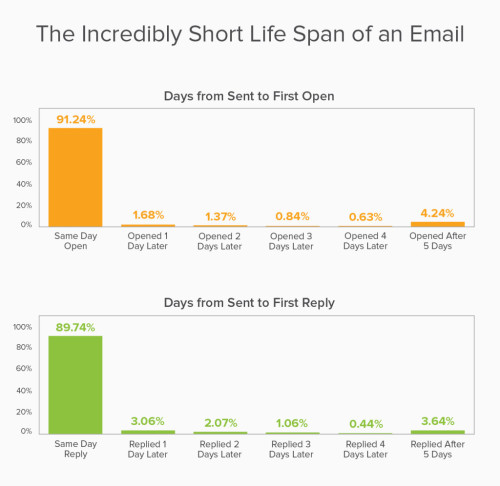
“So what’s all the fuss about these findings?” I hear you cry? Well, drawing on data from over 500,000 (half a million!) sales emails sent by Yesware users in the first quarter of 2014, Yesware found that if an email is ever going to be opened by it’s intended recipient, 91% of the time it’s opened within 24 hours after it’s been sent. Furthermore, 90% of emails that received replies were also replied to within 24 hours after they were opened. That means that during that first day, over half of opened emails were replied to within 3 hours.
 email-life-span-1024x996Source: Yesware

BUT (and it’s a big ‘but’), after Day 1 (i.e. that first 24 hour period) has passed, the chances of your email being opened falls to just 1.7% on Day 2 and decreases thereafter. The same applies for email responses. If you haven’t received a response to your sent email after 24 hours the likelihood of it being replied to falls from whopping 90% to a very measly 3%.

But what does this prove? Well, it proves that the life span of an email is incredibly short and if you do not receive a reply to an email you’ve sent to a candidate within a 24 hour period you will, most likely, NOT receive a reply from that candidate.

So, what’s to be done about it? How can you improve your email open and response rates and ensure that your candidate emails have the best chance of being read and replied to? According to Yesware’s research, there are 2 ways:

  1. Follow-Up Emails
  2. Strategic Timing

1. Follow-Up Mails
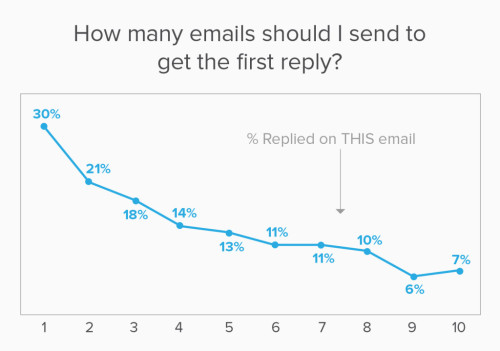
If you haven’t received a response from a candidates within a day or two, email them again. Now we know what you’re thinking; “But, I don’t want to seem annoying or pushy” and yes we do understand that it isn’t easy to strike a balance between adding value and being annoying, but Yesware have run the numbers and discovered that if you didn’t receive a reply to your first email, you have a 21% chance of getting a reply to a second follow-up email. And if you still don’t receive a reply to your second email, there’s still a 25% chance that you will eventually hear back from the recipient.
graph2-1024x719 Source: Yesware

What this chart illustrates is that by continuing to send more emails, you create more opportunities for your recipient to reply. It is a study in scale. Greater volume of emails should correlate to greater total response, and the chart above shows this to be true.

No matter how great your email was, half of the emails you send WILL get blocked by spam filters. Do not let this put you off. Just because someone did not reply to you does not mean that they are not interested. Silence does not mean “no“. “No” means “no”, so chase up the replies until you get one. Remember, people are busy and they may just have forgotten about the email you sent them. They could have been in a meeting at the time it arrived or on the phone to their spouse. All you need to do is remind them that you reached out to them.

Quite by accident, we discovered that if we forwarded the original unanswered email to the same person with additional text at the top such as “Hi Jane, in reference to my email below from last week, can you come back to me today to let me know if this would be of interest?”, most of the time we would receive a reply that suggested that the person either never received our first mail or received both the new mail and original mail at the same time, i.e. it had been caught in spam but the act of forwarding the original message with some new text bounced it out of the spam filter. The rest of the time, people either weren’t interested or they just forgot to reply. Either way, you likely spent a lot of time searching for this person, so rule them in or out before you re-start your search.

Worst case scenario, they say no, in which case you ask them if they would be able to refer you to anyone else who might be interested, and best case scenario, they say yes.

Bottom line: It pays to follow-up.

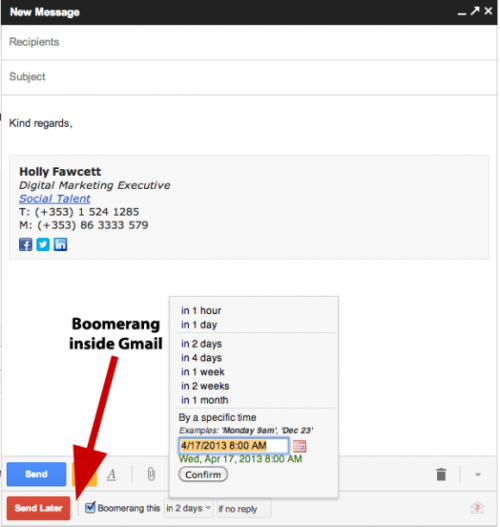
P.S. If you’re worried you’ll forget to follow-up along with everything else you’re trying to get done in the day, don’t be. Boomerang is an excellent application that prompts you to follow up with emails sent out if no response is received, or schedule your emails to send (using the “Send Later” function).
Boomerang-Screenshot-e1366027356716

And Boomerang can also alert you as to whether or not your email has been opened and read. It’s a super handy tool for recruiters that makes following up a far less admin-heavy task. Boomerang is available for free on Gmail and can be installed immediately here.

2. Strategic Timing
The next best way to give your email the greatest chance of being replied to is by sending it at a time when there is less competition. Yesware use the example of “Graveyard slot” infomercials to explain this logic and we enjoyed it so much we’re going to explain it the same way.

Basically, the same way people who like to stay up late are more likely to watch infomercials when there’s nothing else on TV at 3am, candidates will be more likely to notice, read and respond to your email when there is little else being emailed.

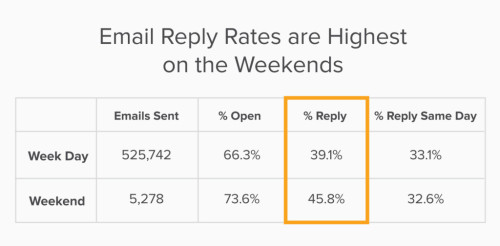
Companies with products like Snuggie and ProActiv have made a traditionally unattractive advertising slot into a very lucrative one as they are targeting a very captive audience. Clever recruiters who choose to send out emails to candidates at a time when no one else is sending emails, could see greater open and reply rates. Take a look at this chart illustrating the difference in open and reply rates for emails sent on weekdays versus those sent on the weekends:
weekendreplyrate-1024x504 Source: Yesware

Take note first of all, of the number of emails sent on weekends versus the number sent on weekdays. Over 520,000 less emails are sent on weekends then on weekdays, meaning emails sent on weekends are 11% more likely to be opened than those sent on weekdays and are almost 18% more likely to be responded to.

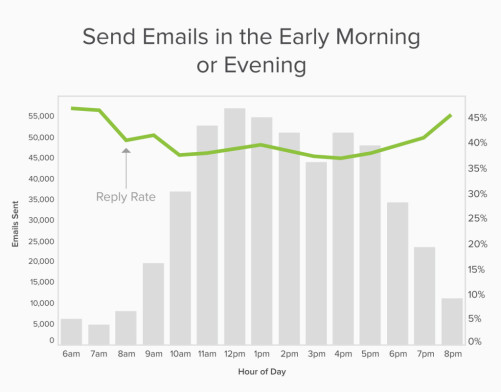
And the same line of thinking applies to emails sent over a 24 hour period:
timeofday-1-1024x802 Source: Yesware

Emails sent earlier in the morning and late at night had a far greater percentage chance of being opened by their intended recipients, simply because less emails are sent at those times. Emails sent between 6 and 7am and those sent around 8pm were the most effective at getting a response, with reply rates hovering around 45%.

Conclusion
Finding good candidates takes a lot of time. You know that! So when you’ve found a great candidate be sure to rule them in or out before you re-start your search. Remember:

  • Follow up, follow up, follow up! If you don’t receive a response from your candidate to your first email. Send another one. Send numerous emails if you have to. The more you send, the more opportunities  you give the recipient to reply. And if you think you won’t remember to follow up, download Boomerang and let it do the work for you.
  • Be strategic with the time and day you send your emails. Your candidate will be more likely to see your email when they are receiving less emails in general. Email open and reply rates tend to be at their highest on the weekends, when inbox competition is low and people are most responsive in the early morning or later in the evening, so experiment with sending emails between 6 and 7 AM, or around 8 PM.

Then get ready to watch your candidate response rates soar!

button to subscribe to NPA blog


It’s Time to Embrace Cloud Recruiting Software

by Veronica Blatt

cloud-computingToday’s guest post is from our newest Alliance Partner. JobAdder manages and organizes the recruitment process for anyone who hires people, offering simplicity, mobility and superior support. Learn more about JobAdder and connect with us on Facebook, Twitter and LinkedIn. We’re excited they’ll be part of our upcoming Global Conference!

Is “top drawer-ing” of resumes, and working straight from your email inbox a way of life for your company? If so, it’s time to consider a cloud based software solution to help power your recruitment process.

Here are just a few reasons to be considering cloud based recruitment software:

Scale easier: Does your agency have growth plans? Cloud based software offers your company the ability to easily add users any time in a few simple clicks. There is no additional software to install and very little training required for new users.

Reduced IT costs: With cloud based software, recruitment related IT costs can be dramatically reduced. It is no longer necessary to have a network, servers, Exchange and expensive IT support contracts. You can also run your business on low spec PCs or Macs as the machine itself is doing so much less than it once might have. Many of our clients, for example, run their businesses with the lowest spec iMac on every desk and no networks, no servers and no desk phones.

Accessibility: Access your recruitment database anywhere, anytime on any device when you make the switch to a cloud based software. There really are no limitations to where you take your business. Flip open a laptop, tablet or mobile device and get recruiting.

A single source of truth: Spreadsheets and Word docs are tedious and allow little visibility into the overall activity of your company. With a cloud based recruitment platform all activity, candidates, resumes, jobs, companies and contacts are in one central location, providing the whole business with a single source of up to date information.

Streamlined Process: One recruiter uses a spreadsheet, the other keeps multiple word documents saved locally to manage their job ads. With cloud recruitment, you can set up company wide email templates, job ad templates, reports — just about anything you want, to streamline recruitment processes for your entire company.

Increased Collaboration: Share candidates with your team, duplicate job ads, split fees — whatever you’d like. By using a recruitment software that’s cloud based, the options for collaboration are endless.

Stay up to date: So long licensing software! With cloud based software, you have peace of mind that your company is staying up to date with the latest trends in recruitment. New product releases simply appear one day when you log in. No more expensive, painful software upgrades — just happy Monday morning surprise when you log in to find new features to help you recruit better.

Has your company found a cloud based software solution? Comment below and tell us how a cloud based software solution has helped your company!

image courtesy of hywards / www.freedigitalphotos.net

button to subscribe to NPA blog


Why the Best Candidates May Not Be Applying to Your Positions

by Veronica Blatt

apply-now-buttonOur guest blogger is Judy Tilmont, owner of JST Search Group in Indianapolis, Indiana (USA) and a member of the NPAworldwide Board of Directors. JST Search Group places professionals in a wide range of manufacturing, engineering, operations, and finance roles.

Okay, so you’ve written the perfect job ad. You’ve paid to have it highlighted on page one of Indeed. You’ve brought it to the attention of everyone on LinkedIn with even one of your keywords in their profile, and you’ve tweeted out the link to everyone on Twitter. Your metrics show that people are visiting your website and reading your job post. Your position is with a great company in a favorable location. Why, oh why, aren’t candidates applying for this position?

Have you ever gone through your online application process? I was helping a very close friend negotiate the online job market this month. She found the perfect job and she believed herself to be a great fit for the position. The last line of the job posting was the killer for this applicant. “Please apply on our company website.” I told her, “It won’t be difficult. They just want some contact information, salary history and a copy of your resume.” Shows you what I know. The job portal at this company had 18 pages that required data to be entered. Not only did they want an MS Word copy of the resume attached, they wanted her resume recreated and educational history back to grade school. And the last page instructed her to write a cover letter including salary expectations.

The internet has made searching for a job a far easier exercise than it was even five years ago. It also has made the online application process a nightmare. If you are asking high-powered, in-demand candidates to apply on your site, have you checked lately to see if your portal is helping or hindering your efforts? Is the process so cumbersome that the best candidates are throwing their hands up in frustration at the time required or the duplication of information found on a well-formatted resume? It’s possible that in your effort to streamline your process, you are turning away the candidates that are most suited for your company.

I challenge all hiring authorities and third party recruiters to go through your portal. Pick a job and actually apply. Ask yourself the following questions as you go through the exercise:

  • Is this information necessary to pre-screen this candidate for this position? Is it necessary to decide that I am interested in talking to him or her?
  • Will this information be duplicated in a well-written resume?
  • Do I need this information if I am not going to hire this person?
  • And most importantly, does everything work?

If you are asking for more than you need to properly pre-screen candidates, you may want to rethink your online application process. Your process should be encouraging a large pool of candidates to actually apply to your postings, not just to read them.

Image courtesy of Stuart Miles / www.freedigitalphotos.net

7-trends


Banking Industry’s Acute Need for Qualified Candidates

by Veronica Blatt

bank-imageToday’s guest blogger is Liz Carey, network coordinator for NBN. NPAworldwide and NBN merged in September 2014, and our two networks are working toward a full integration effective January 1, 2016. We look forward to having Liz as a regular part of our blogging team.

Employment in banking fields is blossoming as the industry emerges from the financial crisis. The problem is, everyone is looking for the same types of candidates, and those candidates are hard to find.

“Everybody’s looking for people from 3 to 7-8 years’ experience,” said recruiter Jim Pruitt of Bankers Crossing in PA, an executive search firm founded in 1984. “There’s actually more jobs out there than there are people. There’s such a shortage.” Read the rest of this entry »


Tips for Using Twitter at a Conference

by Veronica Blatt

Mel-Kettle-PhotoMel Kettle is a communications and social media consultant, speaker, blogger, educator, coach, bookworm, obsessive foodie and eatie, and a budding photographer. She blogs on marketing and social media at www.melkettle.com.au. Mel is passionate about working with organisations to show them how to communicate effectively so they can develop communities, share their stories and raise awareness. She particularly enjoys working with people who want to make a difference to other people’s lives. In her spare time Mel writes a food blog, The cook’s notebook.

With the NPAworldwide Global Conference coming up soon, I thought I’d share a few of my tips about how to use Twitter to help you get the most out of the event. Twitter is a fabulous way to network and interact with people online, and it can be a great way of getting to know people before meeting them in real life at a conference. Read the rest of this entry »


Global Recruiters Expand!

by Dave Nerz

rocket-launchHave you heard? There are 100 finalists for the job opening called “Mars Astronaut.” That is right, an organization (www.mars-one.com) is planning a manned mission to Mars on 2024. They are narrowing down their candidate shortlist. There are many interesting facts about this trip on this site but here are a few I have read about on various sites:

  • 24 people will be selected from the 100
  • Cost of the mission is estimated at $6.0 Billion
  • The trip will take more than 200 days
  • No one is returning to Earth…aka one-way!
  • Astronauts could start dying in less than 100 days due to oxygen issues

This got me thinking about really difficult recruiter assignments. This assignment might be easy when it is new and there is a novelty about the “position” as there is now. In time, this would be a very challenging position for global recruiters to work. I currently think about global assignments as being difficult to attract and gain candidate commitment for, but what about those not even on our globe?

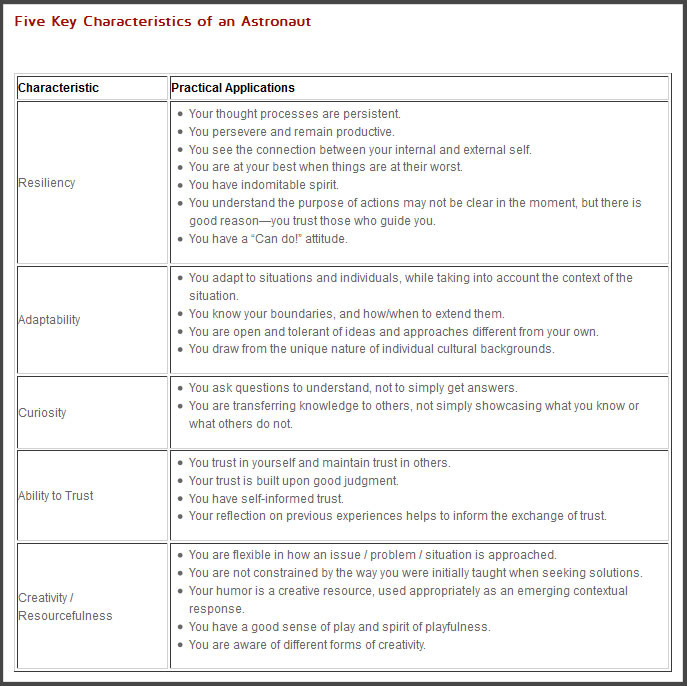
The position description is not listed on the site but the characteristics of the successful candidate are. The major requirements for this extra global assignment are resiliency, adaptability, curiosity, ability to trust, and creativity. I think I would add thrill seeker, death wish orientation, and good in tight spaces. Those with close friends and good family relationships need not apply.

astronaut-characteristics


Maximize Your Split Placement Membership

by Sarah Freiburger

30390724.thbAs the Director of Membership for a split placement network, I am often surprised when months pass by from an inactive member, and then they state they are not getting a good return on investment. This recently caused me to think of our network as a gym, with the membership goals and results really lining up with the work that goes into either. Here are five ways to maximize any type of membership, whether it be a gym, professional association, or split placement network. Read the rest of this entry »


3 Situations that Call for a Split Placement

by Veronica Blatt

papaya-halfNPAworldwide is a split placement network. We’ve been helping our members make splits for more than 50 years, so we pretty much think splits should always be considered. If you haven’t made up your mind yet about splits, or aren’t sure how they could benefit your business, here are 3 situations where a split placement is a great option.

The job is outside your specialty / focus area. Let’s suppose you are a recruiter who fills audit and other accounting-type roles. Out of the blue, your best client comes to you and says they need a digital marketing manager. You don’t know the first thing about digital or marketing. With no resources of your own, your only real option is to tell the client you can’t help. That means some OTHER recruiter will get the job. BUT … if you’re willing to share the fee and make a split placement, there’s no need to send your client looking for assistance elsewhere. You keep the relationship AND your client doesn’t have to go through the hassle of finding and selecting ANOTHER recruiting partner for what may be a one-and-done situation.

The location is outside your geographic coverage area. Let’s change the example slightly. Instead of a job that is outside your expertise, your best client needs to hire an auditor. In Singapore. You don’t know anything about Singapore – what language is spoken, what the educational background is for an auditor, or even how much money an auditor should be making. And Singapore is 13 hours ahead of you, so you’re not looking forward to trying to actually talk to any candidates. Again, you really don’t have the capability on your own to confidently say yes. This is another perfect situation for a split placement. A partner in Singapore can help source candidates in the local time zone, will understand the business culture and customs, and knows how to structure the offer. You manage the relationship with your client so the process is seamless.

You have “leftover” candidates from a recent retained project. Sometimes we hear from recruiting firms that mostly work on a retained basis wondering if split placements are a viable option within their business model. My opinion is they certainly can be! One of the best ways for a retained recruiter to make a successful split placement is to market the “leftover” candidates from retained searches. If you’ve presented 3 candidates to your client and 1 received the offer, what do you normally do with the other 2 candidates? They are qualified candidates who have been vetted and are open to a career change. Why not market those candidates to a split placement partner with a similar job opening? Especially in a candidate-short market like we are experiencing now.

These are three obvious situations where a split placement can be the best solution. There are plenty of other good reasons to have split placements in your business mix. What’s your favorite? Comment below!

image of explore membership button


Demand for High-Level Accounting Talent is Strong

by Veronica Blatt

accountant-adding-machineToday’s guest blogger is Liz Carey, network coordinator for NBN. NPAworldwide and NBN merged in September 2014, and our two networks are working toward a full integration effective January 1, 2016. We look forward to having Liz as a regular part of our blogging team.

The accounting industry is faced with change. Tighter financial regulations are causing both small and large firms to battle for talent. This competition for talent is leading to more – and better – opportunities for accounting and finance professionals.

Financial professionals are needed in various industries, from jobs in Big 4 firms to roles with professional services firms, hedge funds and banks. As the economy recovers, executive and senior level roles are opening up, and companies are having a hard time finding accounting talent for roles with the potential for advancement to become partner, director or CFO.

For example, on a recent networking conference call with nearly 20 of the top accounting and finance recruiters in the US, firm owners were seeking to fill hot job orders such as associate director of commercial contracting and government reporting, director of accounting and reporting, director of corporate compliance, international account executive, and VP, retail product manager.

There is a growing shortage of entry-level professionals with leadership skills as companies look to groom new hires for executive-level and partner roles. A recent survey of corporate executives, done by Competency Crisis and the American Productivity & Quality Center (APQC), found that leadership is the most needed – and least possessed – competency skill.

The problem isn’t finding a good accountant, companies say, it is finding an accountant who has the right interpersonal skills to develop into a manager in three to five years. Most are only in public accounting for three to five years, so it takes skill to find one that stands out.

The need for this accounting talent is pushing companies to “up the ante” to entice financial professionals into accounting jobs. Recruitment has been aggressive. Because of the demand, firms are offering better work/life balance, relocation considerations, additional training, competitive salaries and bonuses, and travel and work experience opportunities.

image of explore membership button


Four Things You Can’t Recover

by Veronica Blatt

Barb BrunoToday’s guest blogger is one of the featured speakers at our upcoming Global Conference. Barb Bruno, CPC, CTS is recognized as one of the top trainers in the staffing and recruiting profession worldwide. She is the owner of HR Search, Inc,  speaker, consultant, author and her mission is to help her clients become more successful. Her bi-weekly NO BS Newsletter is the most widely read newsletter in the staffing and recruiting profession. Her Top Producer Tutor training program has increased sales and profits for 100% of her clients. She has also created a Career Portal for job seekers which she has private labeled for over 500 firms, which allows staffing and recruiting firms to help 100% of the job seekers they attract. Barb  is known for her creative strategies, innovative ideas, high energy, sense of humor and passion for her profession. 

Four things you can’t recover:

  • The word; after it’s said.
  • The occasion; after it’s missed.
  • The time; after it’s gone.
  • The stone; after it’s thrown.

THE WORD; AFTER IT’S SAID
Most recruiters are great talkers and don’t focus enough on improving effective listening skills. Are you making WWD (What We Do) presentations, or do your conversations focus on what’s most important to the other person? People would rather talk about themselves than anything you’re trying to sell to them. It is difficult to realize that our candidates and clients don’t really care about our opinion. That is why it’s so important to always focus on the benefits your candidates and clients will enjoy as a result of having you represent them.

It’s especially important to be aware of what you say when problems occur. This is when you have to be at your best. It’s important to develop an “outside | in” attitude, always seeing your services through the eyes of your candidates and clients. When you develop this attitude you won’t have to recover your words!

THE OCCASION; AFTER IT’S MISSED
You have occasions every day to land your best client or attract additional top talent. Each day, you are capable of changing someone’s life for the better! If you don’t arrive at work each day with high expectations of yourself, opportunities will go to your co-workers or competitors.

Did you think of attending a conference but didn’t think you could afford to go? If that is the case, you are the exact person who should have attended.

Did you consider attending a networking event – but instead went home? You never know where you will meet the top talent you want to represent.

Life is too short to miss out on taking advantage of all opportunities and occasions that present themselves.

THE TIME; AFTER IT’S GONE
Focus on today and tomorrow. See the endless opportunities at your fingertips. If you want a record year this year, know your numbers and commit to hit the goals you set. If you have not attained your goals one month, the difference is adding to the next month.

You don’t want 2015 to be a “woulda, coulda and shoulda” year. Let’s make 2015 the year that you commit to the level of results you need each day, to consistently hit your production and income goals.

THE STONE; AFTER IT’S THROWN
We are all part of the amazing staffing and recruiting profession. It is important that you remain positive when discussing your competitors to candidates and clients.

If you have an opportunity to promote our profession by writing an article, speaking at an event or being interviewed about the benefits of utilizing a staffing or recruiting firm, accept the opportunity. We change people’s lives every day and it’s time this message gets out to clients and candidates.

Follow this advice and you won’t worry about what you can’t recover!

button to subscribe to NPA blog


Please ensure Javascript is enabled for purposes of website accessibility