Global Recruiting

Banking Industry’s Acute Need for Qualified Candidates

by Veronica Blatt

bank-imageToday’s guest blogger is Liz Carey, network coordinator for NBN. NPAworldwide and NBN merged in September 2014, and our two networks are working toward a full integration effective January 1, 2016. We look forward to having Liz as a regular part of our blogging team.

Employment in banking fields is blossoming as the industry emerges from the financial crisis. The problem is, everyone is looking for the same types of candidates, and those candidates are hard to find.

“Everybody’s looking for people from 3 to 7-8 years’ experience,” said recruiter Jim Pruitt of Bankers Crossing in PA, an executive search firm founded in 1984. “There’s actually more jobs out there than there are people. There’s such a shortage.” Read the rest of this entry »


Global Recruiters Expand!

by Dave Nerz

rocket-launchHave you heard? There are 100 finalists for the job opening called “Mars Astronaut.” That is right, an organization (www.mars-one.com) is planning a manned mission to Mars on 2024. They are narrowing down their candidate shortlist. There are many interesting facts about this trip on this site but here are a few I have read about on various sites:

  • 24 people will be selected from the 100
  • Cost of the mission is estimated at $6.0 Billion
  • The trip will take more than 200 days
  • No one is returning to Earth…aka one-way!
  • Astronauts could start dying in less than 100 days due to oxygen issues

This got me thinking about really difficult recruiter assignments. This assignment might be easy when it is new and there is a novelty about the “position” as there is now. In time, this would be a very challenging position for global recruiters to work. I currently think about global assignments as being difficult to attract and gain candidate commitment for, but what about those not even on our globe?

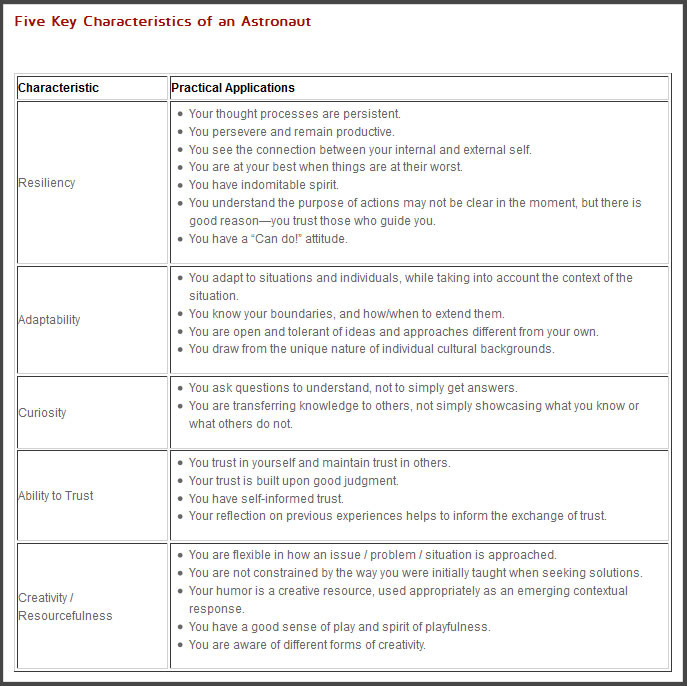
The position description is not listed on the site but the characteristics of the successful candidate are. The major requirements for this extra global assignment are resiliency, adaptability, curiosity, ability to trust, and creativity. I think I would add thrill seeker, death wish orientation, and good in tight spaces. Those with close friends and good family relationships need not apply.

astronaut-characteristics


3 Situations that Call for a Split Placement

by Veronica Blatt

papaya-halfNPAworldwide is a split placement network. We’ve been helping our members make splits for more than 50 years, so we pretty much think splits should always be considered. If you haven’t made up your mind yet about splits, or aren’t sure how they could benefit your business, here are 3 situations where a split placement is a great option.

The job is outside your specialty / focus area. Let’s suppose you are a recruiter who fills audit and other accounting-type roles. Out of the blue, your best client comes to you and says they need a digital marketing manager. You don’t know the first thing about digital or marketing. With no resources of your own, your only real option is to tell the client you can’t help. That means some OTHER recruiter will get the job. BUT … if you’re willing to share the fee and make a split placement, there’s no need to send your client looking for assistance elsewhere. You keep the relationship AND your client doesn’t have to go through the hassle of finding and selecting ANOTHER recruiting partner for what may be a one-and-done situation.

The location is outside your geographic coverage area. Let’s change the example slightly. Instead of a job that is outside your expertise, your best client needs to hire an auditor. In Singapore. You don’t know anything about Singapore – what language is spoken, what the educational background is for an auditor, or even how much money an auditor should be making. And Singapore is 13 hours ahead of you, so you’re not looking forward to trying to actually talk to any candidates. Again, you really don’t have the capability on your own to confidently say yes. This is another perfect situation for a split placement. A partner in Singapore can help source candidates in the local time zone, will understand the business culture and customs, and knows how to structure the offer. You manage the relationship with your client so the process is seamless.

You have “leftover” candidates from a recent retained project. Sometimes we hear from recruiting firms that mostly work on a retained basis wondering if split placements are a viable option within their business model. My opinion is they certainly can be! One of the best ways for a retained recruiter to make a successful split placement is to market the “leftover” candidates from retained searches. If you’ve presented 3 candidates to your client and 1 received the offer, what do you normally do with the other 2 candidates? They are qualified candidates who have been vetted and are open to a career change. Why not market those candidates to a split placement partner with a similar job opening? Especially in a candidate-short market like we are experiencing now.

These are three obvious situations where a split placement can be the best solution. There are plenty of other good reasons to have split placements in your business mix. What’s your favorite? Comment below!

image of explore membership button


Demand for High-Level Accounting Talent is Strong

by Veronica Blatt

accountant-adding-machineToday’s guest blogger is Liz Carey, network coordinator for NBN. NPAworldwide and NBN merged in September 2014, and our two networks are working toward a full integration effective January 1, 2016. We look forward to having Liz as a regular part of our blogging team.

The accounting industry is faced with change. Tighter financial regulations are causing both small and large firms to battle for talent. This competition for talent is leading to more – and better – opportunities for accounting and finance professionals.

Financial professionals are needed in various industries, from jobs in Big 4 firms to roles with professional services firms, hedge funds and banks. As the economy recovers, executive and senior level roles are opening up, and companies are having a hard time finding accounting talent for roles with the potential for advancement to become partner, director or CFO.

For example, on a recent networking conference call with nearly 20 of the top accounting and finance recruiters in the US, firm owners were seeking to fill hot job orders such as associate director of commercial contracting and government reporting, director of accounting and reporting, director of corporate compliance, international account executive, and VP, retail product manager.

There is a growing shortage of entry-level professionals with leadership skills as companies look to groom new hires for executive-level and partner roles. A recent survey of corporate executives, done by Competency Crisis and the American Productivity & Quality Center (APQC), found that leadership is the most needed – and least possessed – competency skill.

The problem isn’t finding a good accountant, companies say, it is finding an accountant who has the right interpersonal skills to develop into a manager in three to five years. Most are only in public accounting for three to five years, so it takes skill to find one that stands out.

The need for this accounting talent is pushing companies to “up the ante” to entice financial professionals into accounting jobs. Recruitment has been aggressive. Because of the demand, firms are offering better work/life balance, relocation considerations, additional training, competitive salaries and bonuses, and travel and work experience opportunities.


image of explore membership button


Modest Hiring Growth Anticipated in Q1

by Veronica Blatt

globesThe Manpower Employment Outlook Survey indicates hiring growth across most global markets compared to Q4 2014. The outlook is generally positive across all global markets on both a quarter-over-quarter and a year-over-year basis. The Manpower survey includes some 65,000 employers in 42 countries. Global markets on the whole are predicting steady growth as opposed to dramatic increases in hiring. Below are some of the key findings: Read the rest of this entry »


Recruitment Forecast 2015

by Dave Nerz

spiral-notebookIf you track the future of recruitment and you do not know Bob Marshall, you should tune in. Bob’s site is www.themarshallplan.org; he is great at providing recruitment analytics and fact-based information on the current status of employment and how it will impact recruitment. Recently, Bob shared some new details in his newsletter regarding the strong positives for the 2015 recruitment forecast.

For global recruiters working the United States as a part of their market, the US GDP increased at an annual rate of 5.0% in the third quarter of 2014; that is an 11-year high water mark. So businesses are doing well and the impact on the search for talent and need for quality employees should have a direct impact on recruiters in 2015. While other global markets and regions are performing at different levels, it is rarely a bad thing to have the US economy doing well.

Another recruitment analytic to consider is regarding job growth. To a large extent, growth is coming from employers with fewer than 500 employees. Seventy-seven percent of US job growth is from small to mid-sized companies. For the average recruiter that is not a part of a large employment brand, this is great news. The future of recruitment should be strong for the small recruiter working with the small and mid-sized employers. So for contingent recruiters, if you have lost your focus on the smaller employers and are working on exclusively bigger employers, your need to consider a shift based on this recruitment analytic.

Finally, unemployment is quite low in the area where most contingent recruiters work: with degreed candidates. Unemployment is just 3.2% in the US for people with college degrees. That is quite low and as we are frequently told, full employment will never be 0%, so 3.2% is close to full employment. Needless to say when we are close to full employment, client companies will be more open to paying for the services of a recruiter. So the near-term future of recruitment looks quite positive in the US.

Get busy building a plan and working that plan. The recruitment forecast is for good times ahead!

button to subscribe to NPA blog


The Silver Tsunami

by Dave Nerz

silver-hairWow! That is a title that evokes fear and perhaps a chuckle at the same time. For anything to keep the attention of the media or perhaps even maintain the interest of our information overloaded minds, it needs a catchy moniker. The Beatles started the “British Invasion” that “Baby Boomers” all know. The Boomers have moved onto “Reality TV” and “hashtagging.” Lots to be said for a well-crafted handle!

The “Silver Tsunami” is the title associated with the aging workforce demographic that threatens to overwhelm employers. While it is a global issue, this issue is most alarming in the U.S. and in Western Europe. Global talent will be more difficult to find and retain as the older employees retire in record numbers. Employers will be looking to recruitment professionals to locate the unique skill sets that will be lost in the decades ahead.

Every day in the U.S., 10,000 people turn 65 years of age. This has been the case since 2011. Many older workers have extended their careers and continued their employment as they waited for their retirement portfolios to recover from the Global Financial Crisis. During the GFC, many that were not prepared to retire were laid off or were forced into early retirement. With portfolios recovering, more baby boomers are making a conscious choice to retire now.

Some facts from the U.S. Census to consider:

  • In 2012, 21.3% of U.S. men over the age of 65 remain in the labor force.
  • In 1990, only 17.6% of men over 65 were working.
  • In 2012, 13.4% of women over 65 remain working.
  • In 1990, only 8.4% of women over 65 were continuing to work.
  • People over 65 represent 13.7% of the total U.S. population
  • In 2010, 19% of the total workforce was made up of employees over 55.
  • It is expected to rise to 24% of the workforce by 2050.

What is interesting is that the Silver Tsunami is working both sides of the same issue. Older worker are leaving in high numbers which is one challenge and on the other hand, older workers will make up more of the workforce moving forward…a different but related issue.

As a recruiter, HR professional, or employer do you have a strategy to find, keep and value older workers as a part of your work force plan?

REMEMBER: We are migrating to a new email distribution platform for this blog in January. Please confirm your subscription below in order to keep receiving email updates. Thanks!

confirm-subscription


Top 5 Growth Industries for Recruitment in 2015

by Sarah Freiburger

image of pie chartExciting times are reportedly ahead for independent recruiting firms as the REC Jobs Outlook Survey recently reported a 9% growth in the next two years. For firms, this is a good time of the year to focus on a sector that is rapidly growing, or try to change their focus to include those industries that have hit the top of the list. For students and job seekers, a new survey from Michigan State University has reported that hiring for new graduates is expected to jump by 16% next year. This increase is due to cautious hiring demand the past couple of years that is now taking off. While most of these will not surprise you, it is a good way to stay on top of the year ahead.

1. IT. A healthy 24% of the respondents to Computerworld’s 2015 Forecast survey said that their companies plan to add more IT employees in the year ahead. These were listed as the top 10 IT skills that would be in high demand in 2015:

  • Programming/application development
  • Project management
  • Help desk/technical support
  • Security/compliance governance
  • Web development
  • Database administration
  • Business intelligence/analytics
  • Mobile applications and device management
  • Networking
  • Big data

2. Engineering. This is an industry that will be seeking experienced candidates with more needed year after year. Highly experienced candidates are leaving due to retirement and the next generation needs to be able to fill in those gaps. Graduate recruitment for engineers will definitely experience a big drive in 2015.

3. Finance and Accounting. Clients in the financial services sectors are projecting huge increase in demand for staff. Financial analysts, area sales managers and relationship people, risk specialists and analysts as well as all of the associated IT, marketing, accounting, HR and other back-office people will all add to this sector growing in 2015.

4. Oil, Gas, and Energy. As oil becomes an even greater commodity, other forms of energy supplies will also start to develop, so specialists within the market will be at high demand with industries such as fracking and shale coming to front of the industry.

5. Life Sciences. Any industries that involve healthcare, pharmaceutical or sciences are going to also continue to see growth for years ahead because of the way the world is developing. Increases in the life span of the human race are causing more positions and more specializations to constantly pop up.

If you are looking to start expanding your recruitment firm in to another industry, a good way to do so is through help from other firms and recruiters that you can work with in a network organization.

button to subscribe to NPA blog


A Split Placement Story to Warm You Up This Winter

by Sarah Freiburger

man-reading-newspaperAs December approaches and Grand Rapids is already buried in snow, it is clear to see that winter has arrived. While this is no regular Christmas carol, this split placement tale from recruiters at NPAworldwide will at least bring good cheer. This network using a database connects different recruiters around the world and creates placements. With more than 400 member firms in 32 different countries, strong trading partners are always awaiting. Read the rest of this entry »


Job Seeker Salaries on the Rise

by Veronica Blatt

blue-arrows-growthI took a look at some of the placement data we capture from our members, and it is clear that job seeker salaries are on the rise compared to a year ago. In fact, two-thirds of the placements reported by our members this year involve a salary of at least USD $80,000 annually, compared to 63% of placements a year ago. In each of the past two years, the single largest salary category is $100,000 and above. The growth in job seeker salaries is consistent with a candidate-short market; traditional laws of supply-and-demand are clearly at work.

The highest salaries we have been seeing are in the chemical process and IT / hardware / software / electronics areas. Here is a sampling from the past four months:

  • Plant Manager, chemical industry, $180,000
  • Director of Operations, chemical industry, $175,000
  • Business Systems Project Manager, food & beverage industry, $163,000
  • IT Site Manager, food & beverage industry, $132,000
  • Senior Performance Analyst, software industry, $127,000
  • Senior Project Manager, oil/gas, drilling industry, $120,000
  • Test Engineer, electronics & semi-conductor industry, $118,000
  • Process Control Engineer, chemical industry, $110,000
  • Production Engineer, chemical industry, $105,000

It is interesting to note that in the chemical process segment, we have had both an increase in salaries as well as a decrease in the number of total placements year-over-year. Members are anecdotally reporting that clients are still too slow to hire, in the mistaken belief that there is still widespread unemployment. There is still tremendous demand for candidates (chemical process jobs represent about 37% of the total jobs in our shared database), in spite of the recent decline in the price of crude oil. Candidates have an extremely short shelf-life and are able to command multiple offers. Counteroffers have also increased as companies are reluctant to lose high-value employees, knowing they may not easily find new talent.

There has been a modest increase (6%) in placement activity in the IT / hardware / software / electronics segment, and another modest increase (7%) in the manufacturing / mining / construction /supply chain segment. Jobs in the IT / hardware / software / electronics segment remain especially plentiful and account for approximately 20% of the total openings shared by NPAworldwide members.

Independent recruiters should be in a position to financially benefit due to the rise in job seeker salaries and the continued talent shortage.

image of explore membership button


Please ensure Javascript is enabled for purposes of website accessibility