
Job Seekers

Mobile Job Search Is the New Normal

by Veronica Blatt

It’s official. Mobile job search is mainstream. Earlier this week, Indeed announced its acquisition of MoBolt, a technology platform that allows job seekers to apply directly for any job, from any device. Further, in the same announcement, Indeed reported that half of all Indeed job searches are performed on a mobile device. Yet only a small percentage of Fortune 500 employers provide a fully-mobile job application process. The Indeed/MoBolt relationship means virtually any employer can now accept mobile job applications, without any IT integration.

A recent infographic from Beyond.com indicates that 64% of job seekers prefer to use a smartphone for job search activities because they can search for jobs anytime, anywhere. However, only 8% of survey respondents indicate that it is EASY to apply for a job via their smartphone. Nearly two-thirds of respondents said when they find a job of interest on their smartphone, they wait until later to apply via a desktop computer. Click the image below for the full infographic:
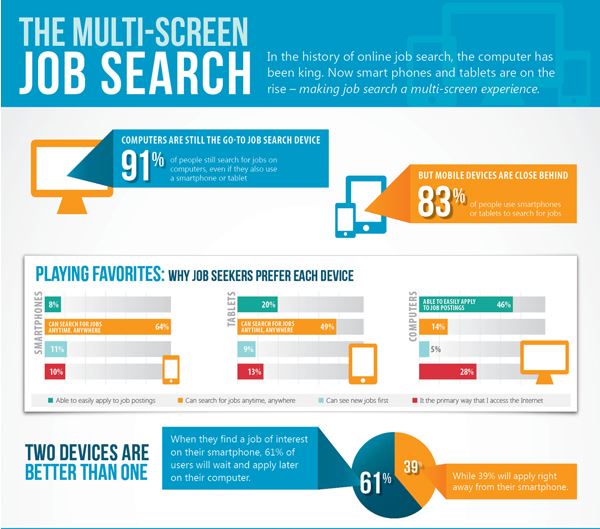
Multi-Screen-Job-Search-Beyond

And here’s the rub: other research indicates that job applications must be received within the first 72 hours after posting or are 50% less likely to even be opened. Forcing job seekers to ‘come back later’ because the mobile application process is so cumbersome means a lot of job seekers won’t come back. Glassdoor says that 75% of job seekers will conduct a mobile job SEARCH, but only 44% will APPLY via a mobile device. That means employers could be losing out on almost half of potential applicants. In a talent short market, who can afford to lose out on even ONE great applicant?

That leads me to my final point. One of the current hindrances to applying via a mobile device is that most people do not have a copy of their resume stored on their mobile device. And most career sites still require a resume to be uploaded. So I ask, is it finally time to  replace traditional paper-based resumes with a digital alternative? LinkedIn offers the ability to apply using your LinkedIn profile, but many profiles lack polish or aren’t up-to-date, and not all candidates are using LinkedIn. Similarly, Indeed offers an “Apply with Indeed” button (ZipRecruiter offers an interesting comparison between the two here), which works well for employers who post on Indeed and job seekers who search with Indeed. True, that represents a lot of employers and a lot of job seekers — but not all of them. And not necessarily the right ones. Could a link to a digital portfolio be an acceptable alternative? Can recruiters and employers and candidates (and ATS’) leverage the visual content trend so that it works for everyone? In my opinion, recruiters and employers who figure out how to turn mobile job search into mobile job applications (with a great user experience) stand to win the talent war big-time.

What are your thoughts on the disconnect between mobile job search and mobile job applications? How are you adjusting your process to accommodate mobile usage?


image of button for free checklist to evaluate split placement networks


Are resumes still a valid recruiting resource?

by Veronica Blatt

image of woman preparing for a job interviewThere are beginning to be more conversations about whether resumes (or CVs, in other parts of the world), are still a necessary recruiting resource. It’s not a new argument. After all, certain types of professionals (visual arts, graphic designers, etc.) have always relied on a portfolio of works instead of a traditional resume. And the idea of being ‘paperless’ has been a much-hyped goal for at least 20 years.

But it feels different to me this time. And I think we might, actually, be at the beginning of the decline of the traditional paper resume.

What’s different?

Well, for one thing, this time around, the conversation isn’t just limited to new media or high-tech Silicon Valley candidates. Some companies are starting to experiment with more ‘traditional’ kinds of roles. Employers are realizing more and more, that a candidate’s ability to ‘fit’ the corporate culture is often just as important, if not more so, than their ability to do the job. It’s tough to get a sense of ‘fit’ from a sterile, one-dimensional resume.

For another, it’s no secret that employers are making “social media research” part of their screening process. While it may be true that such efforts are often a tool to reduce the candidate pool, there are some amazingly great things about candidates that are online. In addition to a LinkedIn profile, there are blogs, digital portfolios, slide decks, and content curation sites like Scoop.it and even, perhaps, Pinterest, that can show a more complete picture of the candidate as a person. It’s early days, and most candidates probably aren’t doing these things (or doing them well), but those who are probably have a competitive advantage.

As for independent recruiters, for whom the resume has long been the ‘gold standard’ by which candidates are measured, The Ladders reports that the average recruiter spends just six seconds (!!) per resume during the initial screening process. Six seconds? It’s tough for me to believe that anyone can make an accurate assessment about anything other than cursory keywords in six seconds. That’s the best recruiting resource to assess a candidate’s potential?

Finally, I believe that the staggering proliferation of mobile devices may very likely cause the death of the resume as we know it. Not this year, maybe not in five years, but I think it’s coming. Candidates are using smart phones for everything. They aren’t storing a resume on their phone. It’s not something they can access easily in a mobile environment. There are now recruiting firms and other services offering suggestions on how to make mobile-friendly resumes. Independent recruiters and employers are increasingly mobile, too, with their own smart phones and (to a lesser degree) tablets. How does that six seconds thing work for you when you’re trying to read resumes on your iPhone? Hiring managers and HR professionals are reviewing resumes on mobile devices when they are away from the office, and the traditional format simply does not translate well to the small screen.

I don’t think the revolution is upon us yet. Resumes are a deeply entrenched part of the recruiting process. It will take time before many traditional employers will be ready to let go and embrace a different (still undefined) alternative.

Are resumes still a prime recruiting resource in your recruitment agency? What do you hear from clients?

 image of explore membership button


Recruiting Trends: College Grad Hiring to Increase in 2012

by Dave Nerz

It looks like 2012 grads will have a better chance of employment than their recent predecessors. The National Association of Colleges and Employers (NACE) has released its annual Job Outlook Survey. The survey is likely good news for both grads and recruiting organizations that provide recruiting resources to recent grads. A separate NACE survey shows  specifically that employers plan to increase hiring of college graduates by 9.5% in 2012, while the current survey details desirable skills or qualities sought by those making hiring decisions for recent college graduates.

The ten most desirable abilities that employers seek in new graduate hires are: Read the rest of this entry »


Please ensure Javascript is enabled for purposes of website accessibility