
 Today’s guest blogger is Stormie Haller. She is the Director of Marketing at Tracker, an AI-native CRM and ATS platform serving recruitment agencies worldwide. With over a decade of experience helping staffing agencies and tech companies shape their marketing strategy, she has become a trusted voice on brand, growth, and the human side of technology adoption. In the post below, Stormie shares insights on candidate engagement strategies to employ in 2026. Tracker is an Endorsed Enterprise Partner of NPAworldwide.
Higher application volume sounds like a good problem to have. It isn’t, not when most of the volume is noise. Candidate engagement has become the difference between a filled role and a stalled pipeline.
This article covers a practical model for the five moments candidates disengage and the strategies that prevent it.
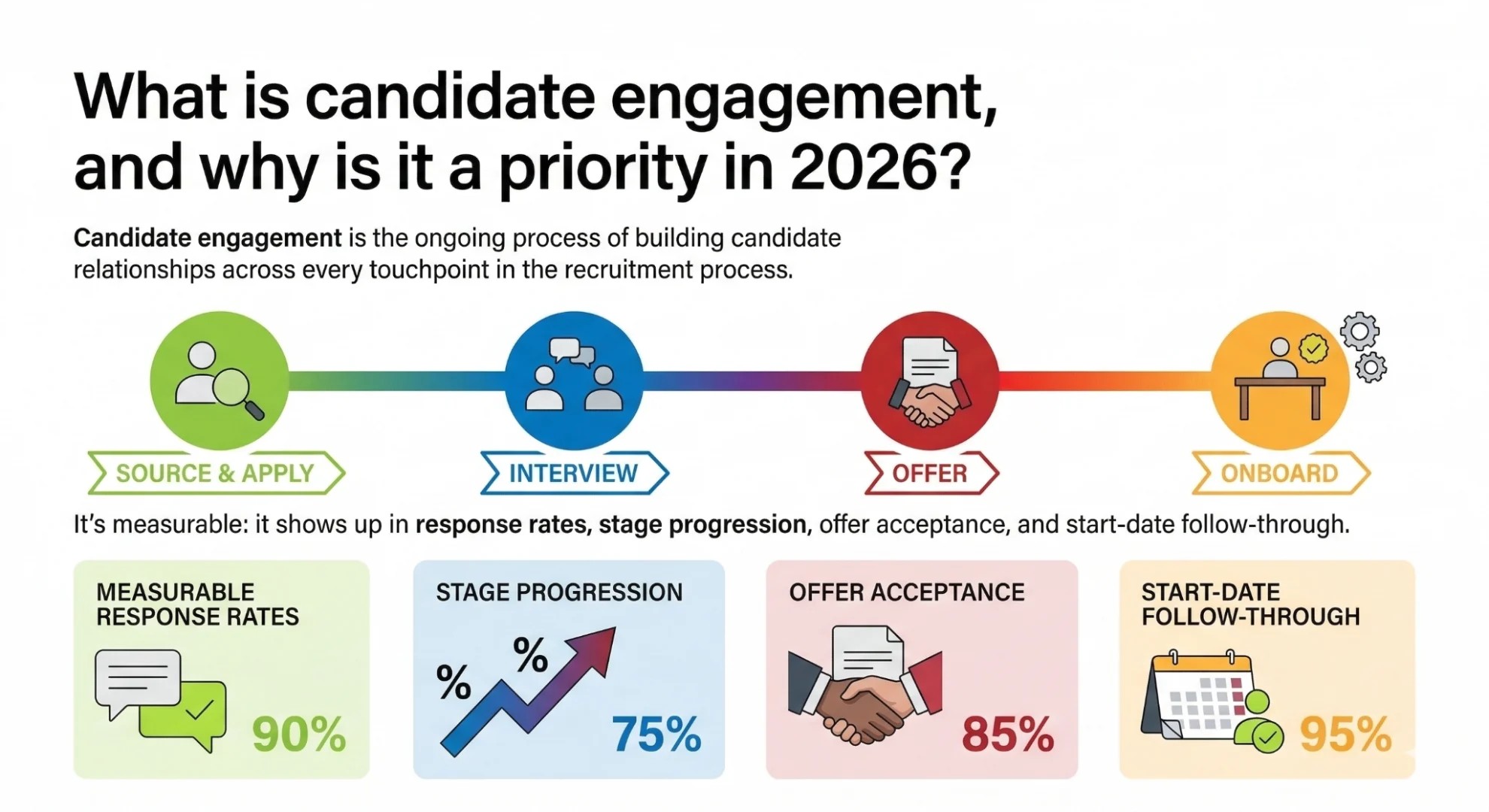
What is candidate engagement, and why is it a priority in 2026?
Candidate engagement is the ongoing process of building candidate relationships across every touchpoint in the recruitment process. It’s measurable: it shows up in response rates, stage progression, offer acceptance, and start-date follow-through. Employer branding is shaped here too, because candidates form opinions about a company based on how the process runs before an offer is ever made.
The core failure mode hasn’t changed. Candidates still hit a black hole when teams don’t set expectations, share timelines, or close loops. What has changed is the cost. Here’s what’s driving that in 2026:
- AI-assisted application volume: McKinsey’s State of AI in 2025 found 88% of organizations now use AI in at least one business function, up from 78% the year prior, driving higher volume with lower signal quality
- Trust erosion from ghost hiring and vague job postings means candidates apply with lower expectations and disengage faster
- Process quality as a signal: candidates read disorganization as a leadership indicator, and a poorly run interview loop loses them to better-organized competitors
- Employer brand exposure through review platforms and peer networks means one bad process experience travels further than one good one
- Skills-first evaluation needs that can’t be validated from resumes alone, requiring more touchpoints and better candidate management
Engagement reduces candidate drop-off, protects employer brand perception, and keeps strong candidates warm for future roles. Proactive engagement across the full talent pipeline is what separates teams that consistently fill roles from those that restart searches from scratch.
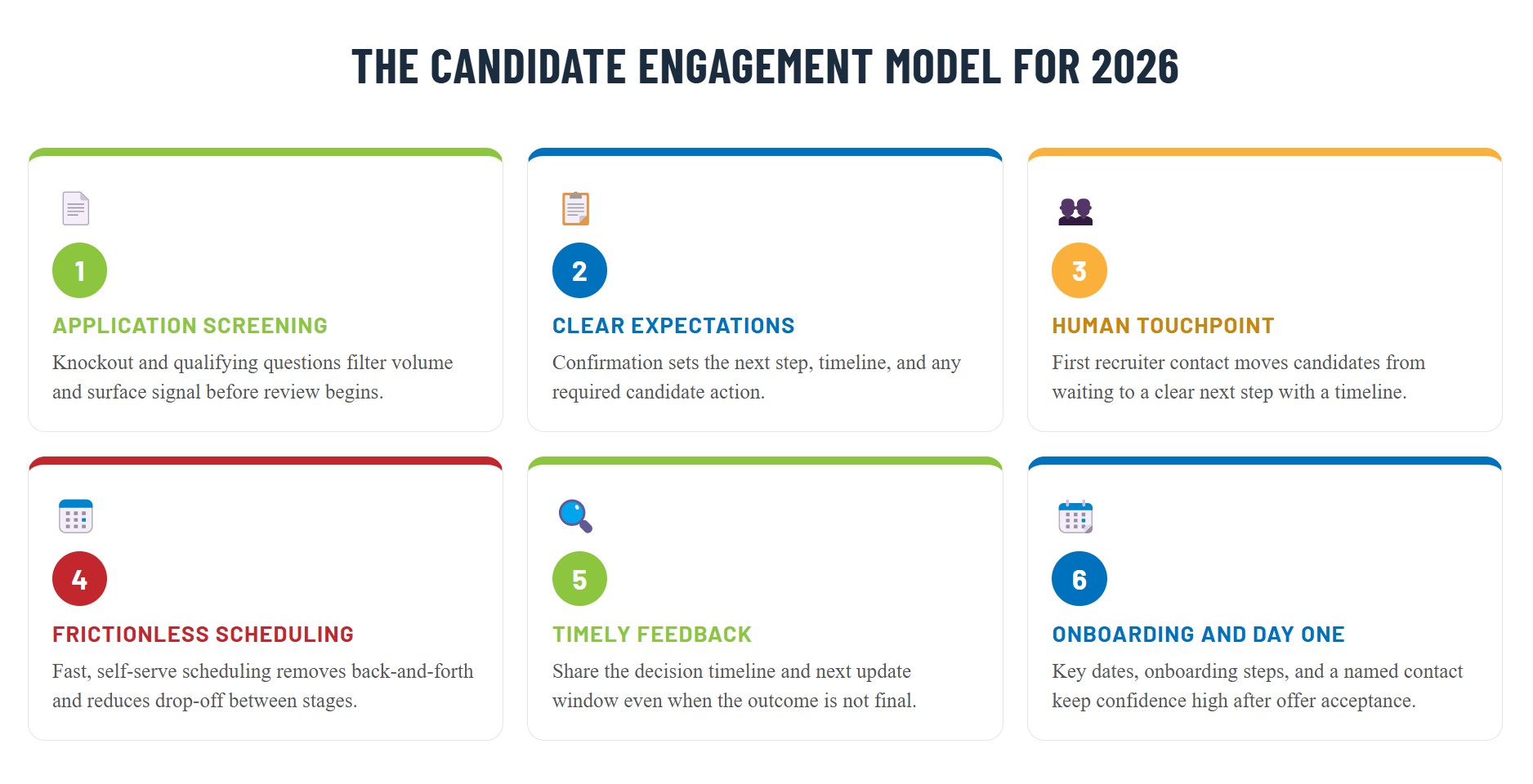
The candidate engagement model for 2026
Most drop-off isn’t random. It happens at predictable moments when candidates lose clarity on what’s happening next. Five conversion gates mark where that drop-off occurs.
- Gate 1: Application screening – Knockout questions filter on hard minimums before recruiter review begins. Job-specific qualifying questions add a second layer, surfacing how candidates think, not just whether they meet the threshold. Both reduce low-signal volume before confirmation.
- Gate 2: Application to confirmation – Confirmation isn’t just a receipt. It needs to set the next step, the expected timeline, and any action required from the candidate.
- Gate 3: Confirmation to first recruiter touchpoint – Automated replies don’t hold candidates. The first human touchpoint needs to move the candidate from passive waiting to a clear next action with a stated timeline.
- Gate 4: First touchpoint to interview scheduled – Drop-off here is friction-driven. Back-and-forth scheduling and unclear ownership are the most common causes, so interview scheduling should be fast and self-serve where possible.
- Gate 5: Interview process to decision – Silence after a candidate assessment or evaluation reads as disorganization. Candidates need a decision timeline and a confirmed update window, even when the outcome isn’t final.
- Gate 6: Decision to start date – Offer acceptance isn’t the finish line. Onboarding requirements, key dates, and a named contact keep candidate confidence high through to day one.
Candidate engagement strategies that keep candidates responsive in 2026
Effective candidate engagement strategies share one thing: they each solve a different drop-off cause. A responsive candidate replies, shows up, and completes the next steps without stalling.
Strategy 1: Set speed and clarity standards that prevent drop-off
Every candidate, at every stage, should be able to answer three questions without asking: what is the next step, who owns it, and when will it happen? Missing timelines and unclear ownership don’t just frustrate candidates. They signal that the process isn’t organized or the role isn’t real.
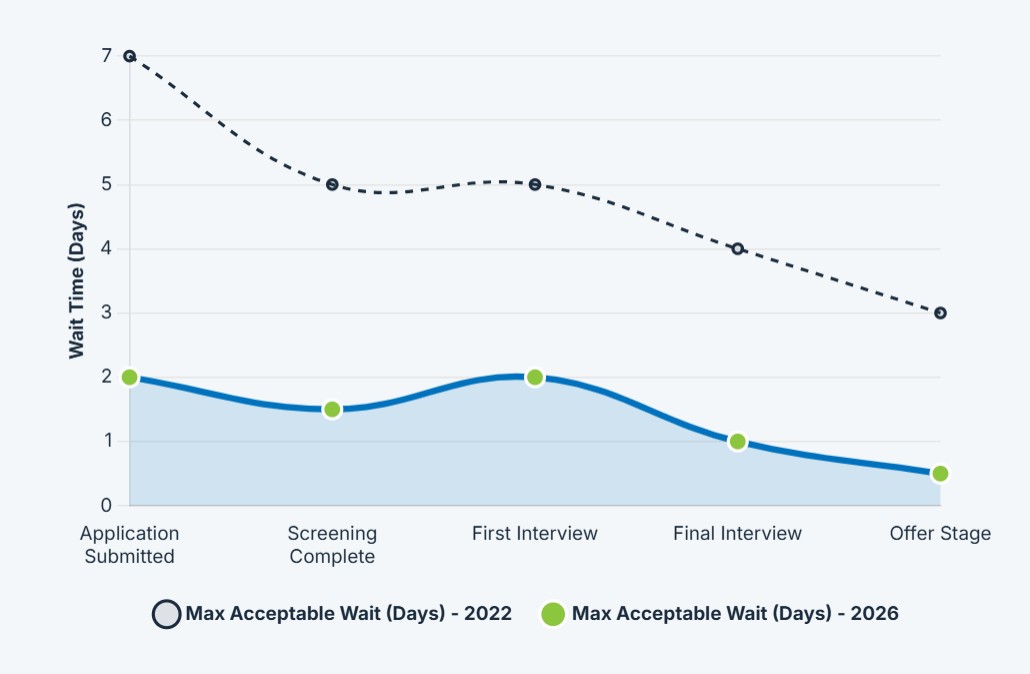
The three update types every process needs:
- Stage progression update: What was decided and what’s next
- Pending decision update: No outcome yet, but here’s the timeline and when to expect it
- Closure update: The loop is closed with a clear outcome
Strategy 2: Remove friction from scheduling and stage movement
Friction isn’t always visible until a candidate goes quiet. Back-and-forth scheduling, slow handoffs, and stages without a named owner are the most common causes of silent drop-off that teams rarely trace back to process.
Scheduling should be self-serve where possible. Reminders reduce no-shows without manual follow-up. One rule that prevents stalls: every candidate in a waiting state has an assigned owner and a next-action date.
Strategy 3: Use reply-first outreach that feels human without manual work
Reply-first means designing outreach so responding is the easiest thing a candidate can do. Personalized communication that connects a candidate’s background to a specific role performs better than generic volume sends. Tracking candidate behavior, such as which messages get opened, clicked, or ignored, tells you which approaches are worth repeating. The components that drive replies:
- Relevance signal: Specific connection between the candidate’s background and the role
- Clear ask: One action, not three options
- Low-effort response path: A reply, a link, or a single-word answer is enough
Strategy 4: Build trust in an AI-heavy process with transparent signals
According to Gartner’s Q1 2025 survey, 32% of candidates are concerned that AI will fail their application, and 25% trust employers less when AI is used to evaluate them. Deloitte’s 2026 Global Human Capital Trends found that only 14% of leaders are adept at shaping human-AI interactions, meaning the gap between what candidates experience and what teams intend is wide.
Candidates need to know what’s automated versus reviewed by a person, what happens next, and when the next update will arrive, even if the decision isn’t final.
Strategy 5: Close loops and keep warm candidates in play
Every candidate deserves an outcome, whether they’re moving forward or not. These aren’t soft courtesies. They’re the minimum standard for protecting your pipeline and your reputation.
Close each active stage with a defined next step and a timeline. For candidates not moving forward, close the loop directly and collect candidate feedback where possible; even a single-question response gives useful data. For strong candidates who weren’t the right fit, invite permission-based outreach for future roles. Clarity protects the relationship better than false optimism, and stronger candidate relationships drive better placements over time.
Strategy 6: Passive candidate engagement strategy that turns interest into applicants
Passive candidate engagement is nurture that earns permission to convert. The goal is to stay relevant long enough that when a passive candidate is ready to move, your outreach is the one they respond to.
Move a passive candidate into the live process when a role closely matches their background, when their behavior signals active consideration (a reply, a click, a profile update), or when prior engagement makes the ask feel warm.
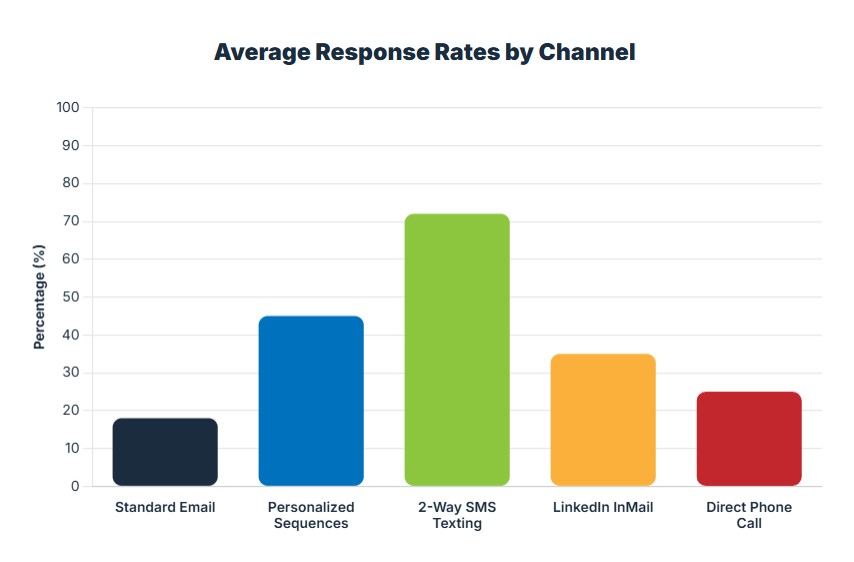
CRM outreach, job alerts, and social media touchpoints each serve a different stage of that nurture sequence. For US staffing teams, pairing email with SMS produces better response rates than either channel alone. Tracker’s SMS engagement webinar covers how teams use text to convert passive interest into active conversations.
Strategy 7: Systemize with candidate engagement software and tools
Candidate engagement tools are only as useful as the system built around them. The goal isn’t more automation. It’s consistent speed, consistent closure, and visible accountability at every stage, especially in high-volume hiring environments where recruitment efficiency breaks down without structured ownership.
Workflow and ownership: Every stage needs a named owner and a defined trigger for the next action. A talent sourcing workflow that maps ownership across the full candidate journey is the foundation everything else runs on.
Communication execution: Automation software handles predictable touchpoints so recruiters focus on conversations that require judgment. SMS campaigns and branded email sequences handle volume at scale. For a practical look at how sequences and ATS workflows support this, see how recruiters can optimize applicant engagement. Tracker’s AI vs. automation ebook covers the operational distinction between the two, which is worth understanding before building your sequences.
Measurement dashboard: Deloitte’s talent acquisition analytics research found that 83% of companies globally have low people analytics maturity. Reporting dashboards need to surface where candidates are stalling, which stages have the highest drop-off, and which roles or recruiters are driving the gaps.
Conclusion: Candidate engagement is a conversion system, not a nice-to-have
Engagement creates a signal, builds trust, and protects speed-to-decision when pipelines are noisy and candidate tolerance for friction is low. The five conversion gates in this model cover every point where candidates disengage, from application confirmation to start date. The strategies above give teams a way to close each one.