
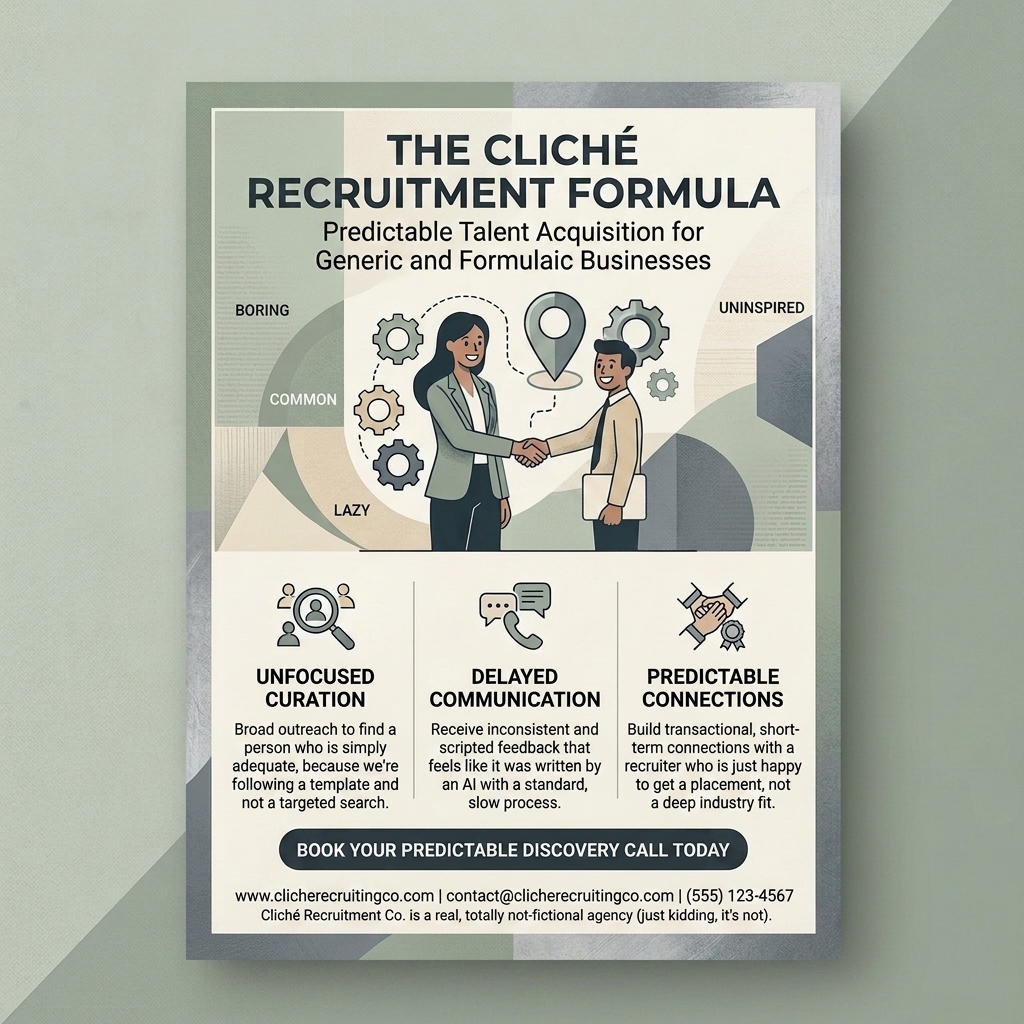
 AI-generated images on recruiter social media posts are increasingly turning off candidates and clients, who read them as a signal of low effort and low credibility. Independent recruiters, whose business runs on trust and human connection, are especially vulnerable to this perception. Authentic, real imagery consistently outperforms AI-generated visuals in building the kind of trust that leads to placements.
Scroll through LinkedIn for five minutes and you’ll spot them. Impossibly polished office scenes. Stock-perfect professionals with suspiciously smooth hands. Motivational graphics layered over AI-generated imagery that looks like it was assembled in thirty seconds …because it probably was.
Audiences have developed sharp pattern recognition for this kind of content. And their reaction? They keep scrolling.
For independent recruiters, that scroll-past isn’t just an engagement problem. It’s a credibility problem. Your social media presence is often the first impression a candidate or client has of you. When that impression reads as “couldn’t be bothered,” you’ve already lost ground before the conversation begins.
What Is “AI Slop” and Why Is It Everywhere?
The term “AI slop” has entered the mainstream as shorthand for low-effort, AI-generated content that floods social feeds without adding real value. It’s fast to produce, easy to scale, and gives the illusion of consistency. That’s exactly why so many creators and professionals reach for it.
The problem is the trade-off. According to research by eMarketer, consumer enthusiasm for AI-generated content dropped from 60% in 2023 to just 26% in 2025. Meanwhile, a January 2026 study from IAB and Sonata Insights found that only 45% of Gen Z and Millennial consumers feel positive about AI-generated content, while 82% of the people producing that content assume their audience loves it. That’s a 37-point gap between creator assumption and audience reality.
Audiences can tell. They notice the slightly-off compositions, the uncanny lighting, the generic visual language that communicates nothing specific about who you are or what you do. And when they see it on a recruiter’s feed, the message they receive is: this person isn’t invested enough to show me something real.
Why This Hits Independent Recruiters Especially Hard
Big companies can absorb some reputational friction from mediocre content. You can’t.
As an independent recruiter, your personal brand is the business. Candidates choose to work with you, not a faceless company, because they believe you understand them, you’re credible, and you’ll advocate for their best interests. Clients partner with you because they trust your judgment and your network.
That trust is built through every touchpoint, including what you post on LinkedIn.
When consumers believe marketing or professional content is AI-generated rather than human, research from MDPI shows they judge it as less authentic and demonstrate weaker engagement. This effect is amplified when the relationship being built depends on human credibility… exactly the kind of relationship independent recruiters cultivate every day.
An AI image on your post doesn’t just fail to impress. It actively undermines the case you’re making for yourself.
The Specific Problem with AI Imagery in Recruiter Posts
Text content is one thing, AI-generated writing can at least be edited and personalized. Images are different. They communicate instantly, before a single word is read.
When a candidate sees a generic, obviously AI-generated image attached to your post about career advice or hiring trends, it creates a split-second judgment: this person cuts corners. Some won’t even read the text. The image has already done its damage.
This matters because social media is now a primary channel for sourcing, building candidate relationships, and demonstrating thought leadership to prospective clients. According to Metricool, engagement drops sharply when content feels mass-produced, brand voice disappears into the noise, and trust erodes over time. For a recruiter whose pipeline depends on people remembering your name and trusting your expertise, that erosion is expensive.
The brands succeeding right now — the ones whose content people actually stop to read — are leaning into authenticity. Not perfection. Authenticity.
What Authentic Imagery Actually Looks Like
Authentic doesn’t mean amateur. It means real. Here’s what that looks like in practice for an independent recruiter:
- Your actual face. A candid photo from your desk, a conference, a coffee meeting, or even a quick selfie at the start of your day. People follow people, not abstract visuals.
- Real moments from your work. A screenshot of a candidate message that made your day (with permission). A photo from a client visit. A picture from a networking event. These images signal that you’re active, connected, and genuinely in the game.
- Behind-the-scenes content. The reality of running a boutique recruitment firm — the good days and the grind — is far more compelling than a polished AI rendering of a professional sitting at an idealized workstation.
- User-generated content. A candidate you placed sharing their good news. A client testimonial with a real face attached to it. This kind of content carries the most credibility of all, because someone else is vouching for you.
Look for authentic reactions, images that feel less posed, real people in real clothing… not actors dressed in corporate attire. The same principle applies to your personal social media presence.
Practical Steps to Fix Your Visual Strategy
Overhauling your social imagery doesn’t require a professional shoot or a significant budget. It requires intention.
Start with your phone. Take a few photos this week that capture real moments from your working life. Build a small library of genuine images you can draw on when you’re posting.
Batch your content. Set aside an hour to take a handful of photos in different contexts: your office, a coffee shop, a client call on screen. Rotate these across posts so your feed feels varied and human.
Use AI where it helps, not where it shows. AI tools are genuinely useful for drafting captions, researching topics, and generating post ideas. That’s the invisible back-end work where AI adds value without undermining trust. The image people see first should be real.
Post less, mean it more. One genuine post with a real photo and a specific, personal insight will outperform five AI-generated posts with generic imagery every week. Reach gets attention; trust keeps people coming back.
Lean into your niche. Your expertise in a specific industry or function is your differentiator. Show it visually: industry events, sector-specific conferences, the real environments your candidates work in. This level of specificity is something AI imagery can never replicate.
Your Feed Is Your First Impression… Make It Count
Independent recruiters have always competed on the quality of their relationships, not the scale of their resources. That’s the advantage of running a boutique firm. Social media is one of the most efficient ways to demonstrate that advantage, but only if your content actually reflects who you are.
AI-generated imagery communicates the opposite of what you want people to feel about you. It signals speed over substance, efficiency over investment, automation over attention. Candidates and clients pick up on that signal faster than you might expect.
The good news: most recruiters haven’t figured this out yet. That means showing up authentically, with real images, real moments, and real perspective will set you apart in a meaningful way.
Put your actual face on your content. Share the real work. Let people see the recruiter behind the posts. That’s what builds the kind of trust that turns followers into candidates, candidates into placements, and placements into referrals.