 Today’s guest blogger is Stormie Haller. She is the Director of Marketing at Tracker, an AI-native CRM and ATS platform serving recruitment agencies worldwide. With over a decade of experience helping recruitment agencies and tech companies shape their marketing strategy, she has become a trusted voice on brand, growth, and the human side of technology adoption. In the post below, Stormie shares four practical tools recruitment agencies can use to apply AI hiring best practices, improve transparency, and keep candidates engaged. Tracker is an Endorsed Enterprise Partner of NPAworldwide.
Most recruitment agencies already know they should pilot AI carefully, tell candidates about it, and keep recruiters in charge of the final call. Tracker covers the reasoning well in its playbook for AI in the hiring process.
The harder part is turning those principles into something your team can use on Monday morning. This post gives you four working tools you can adapt for your own agency.
The effort is worth it. An industry report cited in that playbook found that 70% of hiring managers trust AI-driven hiring decisions, while only 8% of job seekers consider the process fair. Clear, repeatable practices are how you close that gap and keep candidates engaged.
Tool 1: The decision map
Before any tool goes live, write down who owns each decision. A simple table works. Use this one as a starting point and edit it to fit your desks.
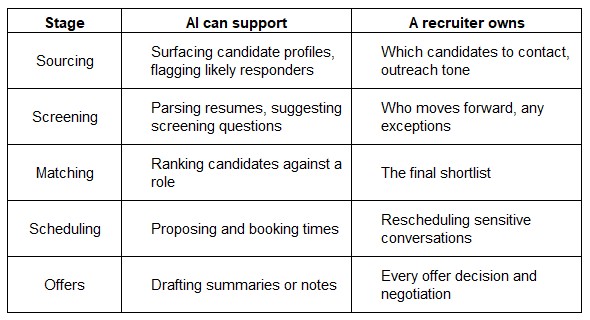
The exact split matters less than the outcome. For any stage, your recruiters should be able to answer, “What did the AI do, and what did I decide?” If they can’t, you have a gap to close before you scale.
Tool 2: Sample disclosure language
Disclosure is easier when the wording is already written. Adapt these examples to your agency, and review them with your legal counsel, since requirements vary by location.
For a job advertisement:
“We use AI tools to help organize and rank applications. A recruiter reviews every shortlist, and people, not software, make all hiring recommendations. Questions about how we use AI? Just ask your recruiter.”
For a first email or text to a candidate:
“A quick note on how we work: we use AI to help match candidates to roles and handle scheduling. A recruiter always reviews your application, and you can ask us anything about the process.”
For a candidate FAQ:
“Does AI decide who gets hired? No. AI helps us sort and summarize information faster so our recruiters have more time to talk with you. Every recommendation to a client comes from a person.”
If your agency uses voice or chat-based screening, add one sentence that says so plainly. Candidates often can’t tell they’re speaking with an AI system until someone tells them.
Tool 3: A pilot scorecard
A 30- to 60-day pilot needs a way to tell whether it’s working. Track a short scorecard instead of a single number:
- Time-to-shortlist: Is the tool actually faster?
- Recruiter override rate: How often do recruiters change the AI’s ranking? A very high rate suggests a poor fit. A rate near zero can mean people are rubber-stamping.
- Candidate drop-off: Do more candidates abandon the process at the stage where AI is involved?
- Candidate feedback: Add one optional question to your post-process survey, such as “Was it clear how your application was reviewed?”
- Sample audit result: Each month, pull a handful of AI-generated shortlists and compare them to what a recruiter would have chosen. Note any patterns that concern you.
Set a decision rule before you start. For example: “If drop-off rises or the audit shows patterns we can’t explain, we pause before expanding.” Deciding in advance keeps the pilot honest.
Tool 4: Talking points for your clients
Your clients are fielding the same questions from their own leadership. Clear language makes you a more useful partner. Cover three things:
- What you use AI for and what you don’t. Share your decision map in plain terms.
- How you check it. Explain your audit cadence and that recruiters review every shortlist.
- What candidates are told. Show them your disclosure wording.
Agencies that can answer these questions confidently stand out in a market where many competitors can’t.
Where your technology fits
The closer your AI sits to the system your recruiters already use, the easier these tools are to apply, because rankings, summaries, and recruiter decisions live in one record. That is the idea behind TrackerAI, which is built directly into Tracker’s ATS and CRM.
If you’re still weighing options, Tracker’s guide to choosing AI recruiting software works as a useful checklist. Its breakdown of AI versus automation in recruiting helps you tell the two apart before you buy.
Putting it to work
Start with the decision map, because it costs nothing and exposes gaps quickly. Next, add the disclosure wording to your next batch of job ads. Then set up your scorecard before your first pilot begins.
For the reasoning behind each guardrail, read Tracker’s full playbook. To see how AI, automation, and recruiter review fit together in one platform, book a Tracker demo.